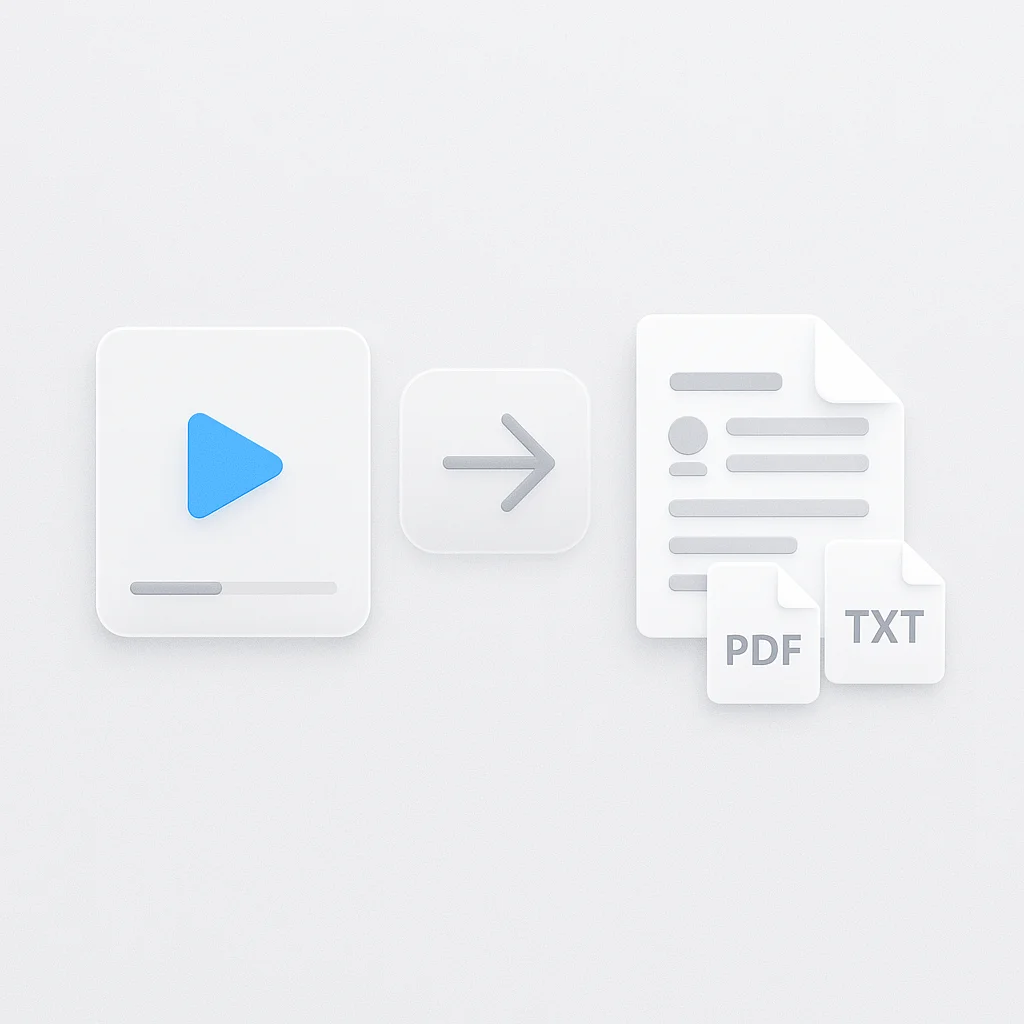
Turn a YouTube Video into a Transcript
Paste a YouTube link into this tool and it downloads the audio, transcribes it, and returns a transcript with timestamps and speaker labels. Use it for a lecture, an interview, a podcast episode, or any video you would rather read than watch end to end.
This tool processes the actual audio, so the transcript matches what was said in the video, not a guess based on the video’s metadata.
What you get:
- A transcript in 100+ languages, with speaker identification and timestamps
- Export as PDF, DOCX, TXT, SRT and VTT
- search across recordings by name or transcript
- AI chat with any recording
- Free plan: 2 transcriptions, up to 45 minutes each, on a free account (no card)
How to Generate a YouTube Transcript
- Paste the YouTube link: Copy the URL from any public video and paste it into the box above. The tool also imports YouTube, Vimeo and direct media links if you need something other than YouTube.
- Let it process: The audio is downloaded and transcribed automatically, with speaker identification and timestamps added.
- Read, search, or export: Search the transcript, ask a question about the video, or export it as PDF, DOCX, TXT, SRT and VTT.
Accuracy depends on the video’s audio. A single clear speaker with no music or crowd noise transcribes more accurately than a video shot outdoors with wind and background chatter. See how we measure accuracy.
YouTube Transcript Generator vs Other Tools
| Feature | ScreenApp | YouTubeToTranscript | YouTube-Transcript.io | Tactiq | NoteGPT |
|---|---|---|---|---|---|
| Free tier | 2 transcriptions, up to 45 min each | free, no limit on the number of transcripts | 25 tokens | 10 transcripts/month | no length limit stated |
| Signup required | Yes, free (no card) | Not stated as required | Not stated | Not stated | no login, installation, plugin or extension required |
| Languages | 100+ | Translation to 125+ languages | Not stated | Not stated | Not stated |
| Speaker labels | speaker identification | Not stated | Not stated | Not stated | Not stated |
| Export formats | PDF, DOCX, TXT, SRT and VTT | copy to clipboard only, no file download | Not stated | TXT | TXT, or copy without timestamps |
| Paid plan | $19/month annual | Not stated | $9.99/month | $8/month annual | $9/month annual |
Sources, checked 2026-10-12: ScreenApp supported languages, Transcription accuracy and languages, ScreenApp pricing, ScreenApp recording limits, youtubetotranscript.com, youtube-transcript.io, Tactiq plan guide, NoteGPT YouTube transcript generator, youtube-transcript.io/pricing, NoteGPT pricing
- vs YouTubeToTranscript: YouTubeToTranscript is free, no limit on the number of transcripts and translates into 125+ languages, but copy to clipboard only, no file download. ScreenApp lets you download the transcript file directly.
- vs YouTube-Transcript.io: YouTube-Transcript.io gives new accounts 25 tokens to spend, then charges $9.99 a month for its next tier. ScreenApp’s free plan is 2 transcriptions with no token count to track.
- vs Tactiq: Tactiq’s free plan is capped at 10 transcripts a month. ScreenApp’s free plan covers 2 transcriptions of up to 45 minutes each.
- vs NoteGPT: NoteGPT needs no login, installation, plugin or extension required and states no length limit stated, but exports only as TXT, or copy without timestamps. ScreenApp exports as PDF, DOCX, TXT, SRT and VTT and adds speaker identification.
Who Needs a YouTube Transcript
Content creators turn a video’s words into a blog post, captions, or a script for another video, without retyping what was said by hand.
Students and researchers paste a lecture or seminar link instead of typing notes during class, then search the transcript for a term when they revise or cite the source with a timestamp.
Business professionals get a text record of a webinar, a recorded training session, or a conference talk they need to document or share with a team that would rather read than watch.
Journalists and writers pull an exact quote from an interview or a press conference, with speaker identification showing who said it and a timestamp for attribution.
Accessibility coordinators turn a video into readable text for anyone who cannot watch it, or use the transcript as a starting point for captions and subtitles.
Language learners read along with a foreign-language video, pausing on unfamiliar words and checking the transcript against what they hear.