Record a Lecture, Get the Transcript and Notes
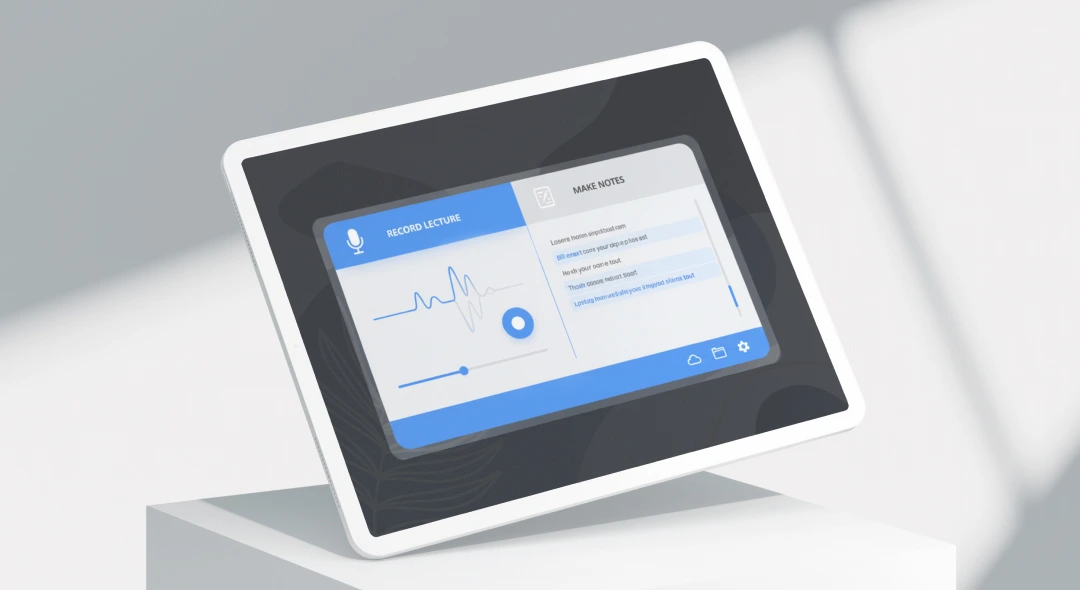
Lecture recorder captures a class from your phone, laptop, or browser and turns it into a searchable transcript with AI notes. Record live, or upload a recording you already have, and read the summary instead of re-listening to the whole hour.
10,483 lectures were recorded on ScreenApp in the last 90 days, across seminars, tutorials, and study sessions. Reviewing a recording at your own pace lets you go back over the parts you missed instead of relying on notes taken mid-lecture.
What you get with every recording:
- A transcript with speaker labels and timestamps, in 100+ languages
- AI notes: a summary, the main concepts, and any assignments or deadlines mentioned
- Chapters, so a two-hour lecture is split by topic
- Ask AI questions about the lecture and get answers that point to the moment in the recording
- Export as PDF, Word, or text
- Free plan: 2 transcriptions of recordings up to 45 minutes each, with AI chat
Recordings are stored in your account and open on any device where you sign in.
How to Record Lectures
- Start recording: Open ScreenApp on your phone or in the browser and press record. On a laptop you can also record a slide deck or a video call with the audio.
- Let it run: Recording continues until you stop it. If you already have an audio or video file, upload that instead.
- Read the notes: Transcription and AI notes are ready a few minutes after you stop. Search the transcript, jump to a timestamp, or ask a question about the lecture.
Accuracy depends on the audio. A phone on the desk near the lecturer works well; a recording from the back of a large hall with side conversations will have gaps. See how we measure accuracy.
Lecture Recorder vs Other Apps
| Feature | ScreenApp | Otter.ai | Rev Voice Recorder | Notability |
|---|---|---|---|---|
| Free recording | 2 transcriptions, up to 45 min each | 300 min/month, 30 min per conversation | Recording free, transcription paid | Needs Plus ($15.99/year) |
| Transcription | Included | Included within the minute cap | $25.49/mo (AI, billed annually), $1.99/min (human) | Included with Plus |
| AI notes and chapters | Included | Pro, $8.33/month billed annually, or $16.99 monthly | No | No AI summary |
| Languages | 100+ | 6 | Not stated | Not stated |
| Offline recording | iOS and Android apps record offline | Otter stores audio locally if the connection drops, with no live transcript | Not stated | Not stated |
| Paid plan | $19/month annual | $8.33/month annual | $25.49/month annual | $15.99/year |
Sources, checked 2026-10-01: ScreenApp supported languages, ScreenApp pricing, Otter pricing, notability.com/pricing, Rev pricing, Otter offline recording guide
- vs Otter.ai: Otter’s free plan caps you at 300 minutes a month and 30 minutes per conversation, and Pro is $8.33 a month billed annually, or $16.99 monthly for 1,200 minutes. Otter transcribes 6 languages (English, Spanish, French, German, Japanese, and Chinese); ScreenApp transcribes 100+.
- vs Rev Voice Recorder: Rev’s recorder is free but transcription is pay per minute at $25.49/month (billed annually) for AI transcripts, so a semester of lectures adds up. ScreenApp’s plans include transcription and notes.
- vs Notability: Notability is a handwriting and note-taking app. Audio recording and transcription need the Plus plan at $15.99 a year, and there is no AI summary. ScreenApp is built around the transcript and the notes.
Who Uses a Lecture Recorder
Students record so they can listen in class instead of typing. Afterwards they read the AI notes, search the transcript for a term, and replay the minute they did not follow.
Medical and law students deal with drug names, case citations, and Latin. A transcript they can search beats handwritten notes for that vocabulary, and the AI notes list the terms the lecturer defined.
Lecturers and teachers record their own sessions to share a transcript and summary with students who missed the class or need the material in another format.
Remote and part-time learners record webinars, online courses, and virtual seminars into one library they can search across the whole term.
Graduate students record seminars, guest talks, and supervision meetings, then quote from the transcript with a timestamp when they write up.
Language learners record classes and read the transcript alongside the audio to check pronunciation and vocabulary.