
Transcribe Chinese Video and Audio, Get the Text
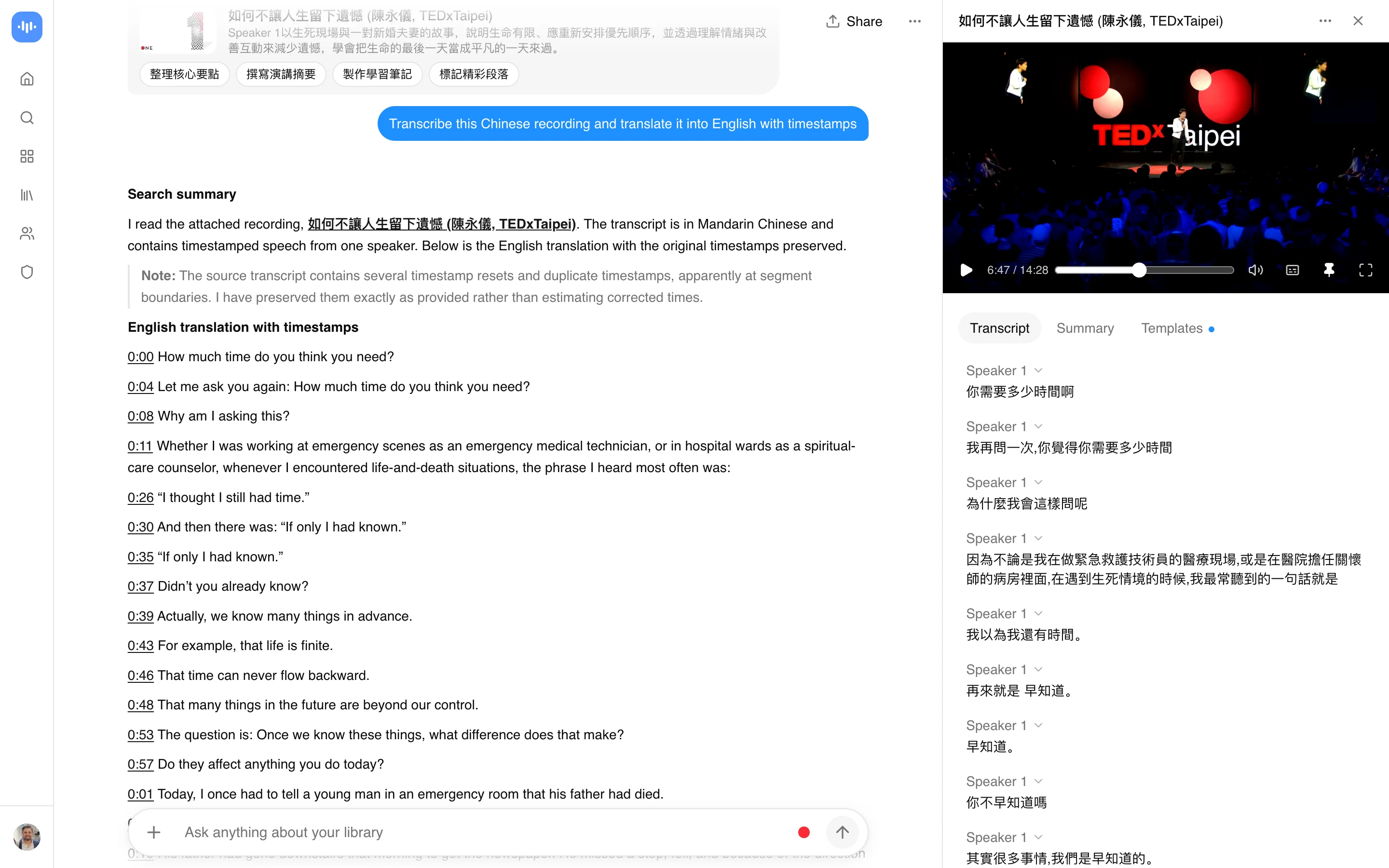
Upload a Chinese video or audio file, or paste a link, and ScreenApp turns the spoken Mandarin or Cantonese into a transcript with speaker labels and timestamps. There is no download step for a URL: paste the link and the tool fetches and transcribes it directly, including links from Douyin, Kuaishou, and Bilibili.
You get a transcript you can search, edit in the browser, and export, instead of replaying the recording to find a quote.
What you get:
- A transcript with speaker labels and timestamps, in 100+ languages
- Export as PDF, DOCX, TXT, SRT and VTT
- Translate the transcript or captions: transcript and caption translation
- Ask AI questions about the recording and get answers that point to the moment it happened
- Free plan: 2 transcriptions of recordings up to 45 minutes each, with AI chat
How to Transcribe Chinese Video to Text
- Upload or paste a link: Drag in your Chinese video or audio file (MP4, M4V, MOV, AVI, WEBM, MKV, FLV, TS, MTS, M2TS, 3GP, 3GPP, 3G2, WMV, ASF, VOB, OGV, RM, RMVB, MPG, MPEG, M2V, F4V, MXF, or MP3, M4A, MP4A, M4B, AAC, WAV, OGG, OPUS, FLAC, AIFF, WMA, WEBMA, MKA, AC3, EAC3, WV, AMR, DSF, DFF) or paste a link from YouTube, Vimeo, TikTok, Instagram, Facebook and most other public video links (Twitch, Loom, Dropbox, Google Drive, Pinterest, X, Threads, Douyin, Kuaishou, Bilibili) through a generic importer.
- Let it transcribe: The Mandarin or Cantonese audio is converted to text, speakers are separated, and every sentence gets a timestamp.
- Search, edit, export: Read the transcript in the browser, edit it, and export as PDF, DOCX, TXT, SRT and VTT.
Accuracy depends on the audio. Clean, single-speaker Mandarin or Cantonese audio with no background noise transcribes best; a distant microphone or overlapping speakers will have more gaps. See how we measure accuracy by language.
Chinese Transcription vs Other Apps
| Feature | ScreenApp | Notta | HappyScribe | Sonix |
|---|---|---|---|---|
| Free trial | 2 transcriptions, up to 45 min each | 120 min/month, 3 min per conversation | 10 min | 30 min |
| Export formats (entry tier) | PDF, DOCX, TXT, SRT and VTT | TXT, DOCX, PDF, or XLSX | TXT, SRT | DOCX, PDF, TXT, SRT, VTT |
| Speaker identification | Included | Included | Not stated on the Chinese page | Not stated on the Chinese page |
| Translation | transcript and caption translation | Not stated on the Chinese page | Not stated on the Chinese page | Not stated on the Chinese page |
| Entry paid plan | $19/month annual | $8.17/month annual | $8.50/month annual | $25/month |
Sources, checked 2026-10-12: ScreenApp pricing, Notta pricing, Happy Scribe pricing, Sonix pricing, notta.ai/en/lecture-summarizer
- vs Notta: Notta’s free plan covers 120 minutes a month, capped at 3 minutes per conversation, and Pro starts at $8.17 a month billed annually. ScreenApp’s free plan is 2 transcriptions of recordings up to 45 minutes each, with AI chat included.
- vs HappyScribe: HappyScribe’s free trial covers 10 minutes, and the free tier’s exports are limited to TXT, SRT; Basic starts at $8.50 a month billed annually. ScreenApp’s free plan exports as PDF, DOCX, TXT, SRT and VTT from the start.
- vs Sonix: Sonix gives a 30-minute free trial with no card required, and Core is $25 a month. ScreenApp’s free plan is 2 transcriptions of recordings up to 45 minutes each, with AI chat included.
Who Needs Chinese Transcription
Content creators and researchers transcribe Chinese-language video to study trends, track brand mentions, and repurpose clips for other platforms without replaying the footage to catch every line.
Academics and language researchers transcribe interviews and field recordings with Mandarin or Cantonese speakers, then code the text for qualitative analysis.
Journalists and content teams turn a Chinese-language interview or briefing into a transcript they can quote from directly, with a timestamp for each sentence.
Businesses working with Chinese-speaking markets transcribe customer calls and interviews to review feedback without relying on a bilingual team member to listen back.
Translators and subtitlers start from a Mandarin or Cantonese transcript instead of transcribing by ear, then translate it for captions or dubbing scripts.
Language learners transcribe authentic Chinese audio or video and read the text alongside the recording to check pronunciation and vocabulary.