

Loom vs. ScreenApp
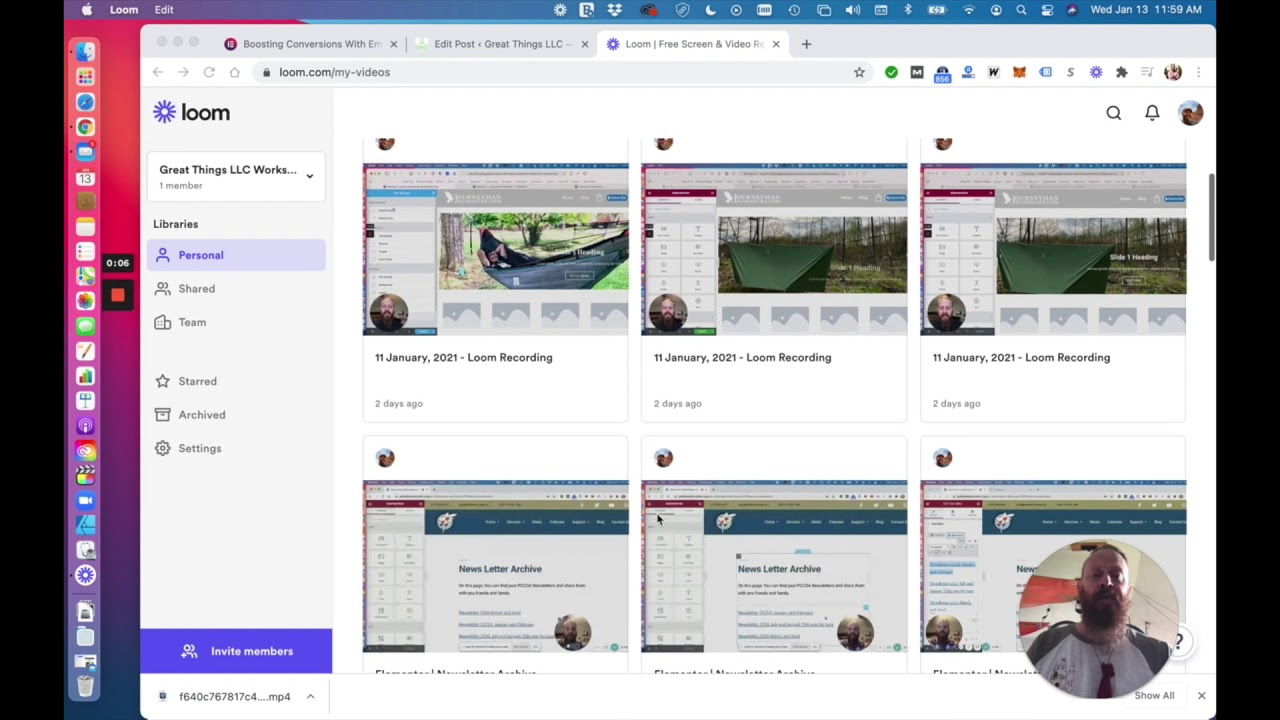
Loom and ScreenApp both record your screen and camera and share the result with a link. Loom is built around short video messages for teams, with viewer comments, reactions and engagement insights. ScreenApp is built around what happens after the recording: transcripts, AI notes and chat across your recordings, including meetings.
ScreenApp did not test Loom for this page. The Loom details below come from Loom’s own pages, checked 18 September 2026.
What is Loom?
Loom records your screen and camera and gives you a link to share. It has apps for Mac, Windows, iOS and Android. The free Starter plan allows 25 videos of up to 5 minutes each, with transcriptions in 50+ languages, according to Loom’s pricing page.
Loom has editing on its paid plans. Business, at $18 per user a month billed annually, includes trim and stitch, basic waveform editing and video uploads, and records video up to 4K. Business + AI, at $24 per user a month, adds auto titles, summaries, chapters and tasks, filler word and silence removal, and auto meeting notes and recap emails, plus edit by transcript. Enterprise adds SSO (SAML) and SCIM provisioning.
What is ScreenApp?
ScreenApp records screen, window, browser tab, microphone and camera, with system audio. It also has a meeting bot for Zoom, Google Meet and Microsoft Teams, and you can record without a bot from the web app, Chrome extension, Mac and Windows apps, or iOS and Android apps. The mobile apps record audio, not the screen.
Each recording is transcribed in 100+ languages with speaker identification. You get chapters with timestamps, action items with an owner and deadline, and decisions listed separately, AI chat with any recording, and one AI chat that searches and answers from every recording in your library, or a single folder. ScreenApp lets you trim recordings, and it has no watermark on any recording or export.
Where they differ
- AI: Loom’s AI features sit on the Business + AI plan and are aimed at the video itself: titles, summaries, chapters, tasks and cleaner audio. ScreenApp’s AI works across the transcript and the video, and you can chat with one recording or your whole library.
- Editing: Loom has more video editing, with trim and stitch on Business and edit by transcript on Business + AI. ScreenApp’s editing is trimming plus transcript corrections, line removal and speaker reassignment saved to the recording.
- Meetings: ScreenApp can send a bot to Zoom, Google Meet or Teams. Loom’s Business + AI plan lists auto meeting notes and recap emails.
- Pricing: Loom prices per user. ScreenApp publishes a per-plan price: Pro at $19/month billed annually ($228/year) or $30/month monthly, Max at $34/month annually or $69/month monthly.
Pick Loom or ScreenApp
Pick Loom if your team sends short video updates to each other, you want viewer comments, reactions and engagement insights, you need trim, stitch and edit by transcript, or your company needs SSO and SCIM. ScreenApp has no SSO.
Pick ScreenApp if you record meetings as well as screen videos, you want transcripts, action items and AI chat across all your recordings, or you would rather pay per plan than per user.
Other Loom alternatives
1. ScreenApp
Records screen and audio, transcribes it, and answers questions about the recording. Free plan: 2 transcriptions of recordings up to 45 minutes each.
2. Camtasia
A desktop screen recorder and video editor for training and educational videos.
- Focus: Long-form video editing.
3. OBS Studio
A free, open-source tool for live streaming and screen recording.
- Focus: Streaming and advanced recording setups.
4. Screencastify
A Chrome-based screen recorder used widely in schools.
- Focus: Education.
5. Snagit
A screen capture and image annotation tool that also records video.
- Focus: Screenshots and annotation.
FAQ: Loom vs. ScreenApp
1. What is the best free Loom alternative?
Both have free plans. Loom’s free Starter plan allows 25 videos of up to 5 minutes each. ScreenApp’s free plan gives you 2 transcriptions of recordings up to 45 minutes each and 3 uploads to try, plus 10 AI chats per month.
2. Is Loom good for training videos?
Yes, for short ones. Loom Business has trim and stitch and records up to 4K. If you need a transcript, a summary and AI chat over long recordings, ScreenApp covers that.
3. What is the difference between Loom AI and ScreenApp’s AI?
Loom AI, on the Business + AI plan, writes titles, summaries, chapters and tasks for a video and removes filler words and silences. ScreenApp’s AI writes chapters and action items, and you can ask questions of one recording or your whole library.
4. How much can my team save by switching to ScreenApp?
Loom’s Business plan is priced per user, so a team of 10 pays ten times the seat price. ScreenApp prices per plan rather than per seat: Pro at $19/month billed annually ($228/year), Max at $34/month billed annually ($408/year). Run both numbers for your own headcount.
5. Can I use ScreenApp for quick video messages like Loom?
Yes. You can record your screen and camera and share a link. Loom has more tools built around the viewer, such as comments, reactions and engagement insights.
Which One to Pick
Loom is a strong choice for teams that talk to each other through short videos. ScreenApp suits people who record meetings and screens and want the transcript, notes and AI chat from them. Loom details and prices are from Loom’s own pages, checked 18 September 2026, and can change.