Can Claude Watch, Analyze, and Summarize Videos?

On this page
Documentation checked September 16, 2026: Anthropic lists documents and still images for chat uploads; its published upload list does not include video formats. This describes the documented chat upload interface, not tools or integrations.
The Claude vision API accepts GIF images but processes only the first frame of an animation.
How to summarize a video with Claude
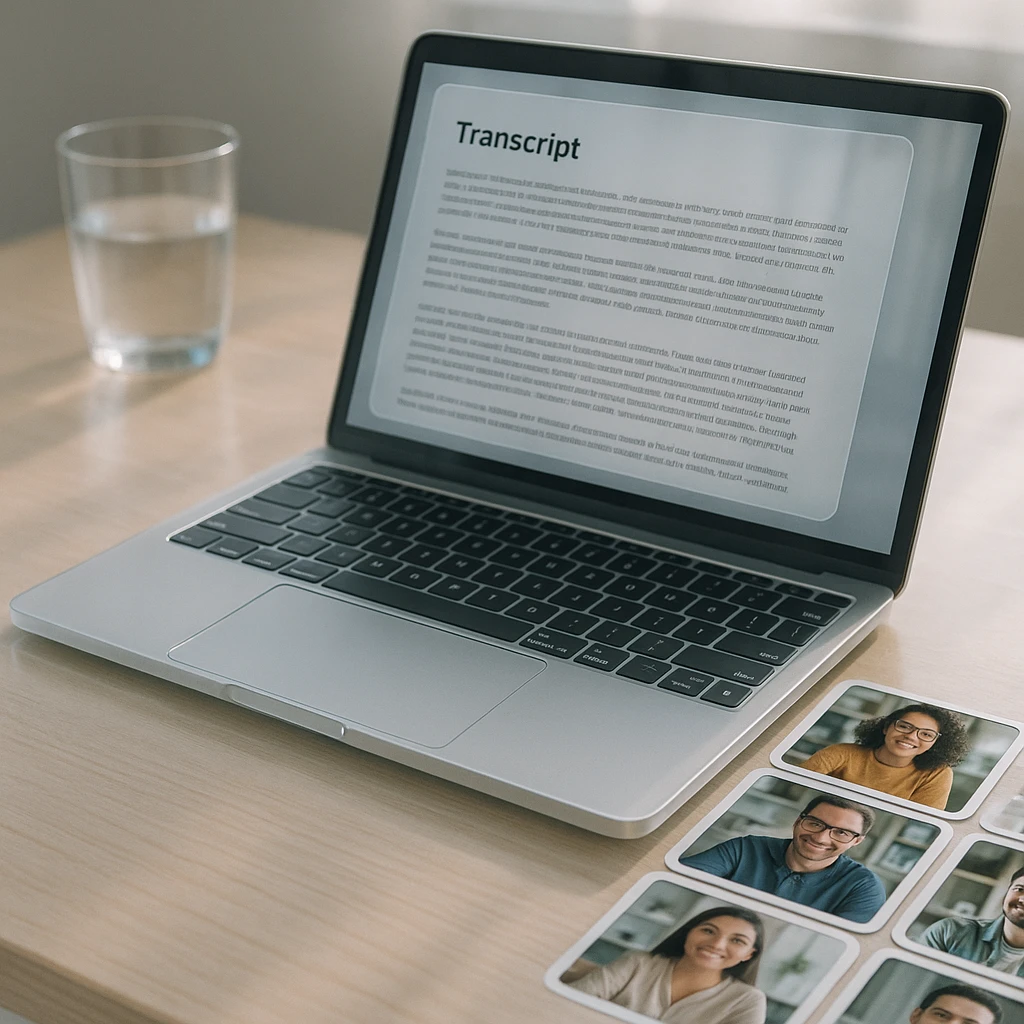
Transcribe the video with a dedicated tool. A video to text converter takes the MP4 or a link and returns a timestamped transcript.
Export as TXT, DOCX, PDF, or SRT. Keep the timestamps; they are what turn a summary into a navigable one.
Upload the transcript to Claude and ask for the format you want: bullet notes, chapters, action items, a study guide, a blog draft.
Verify names, numbers, and anything you plan to quote. Speech-to-text mangles proper nouns, and Claude will confidently summarize the mangled version.
A prompt that earns its keep:
Summarize this video transcript in 10 bullet points with timestamps. Then list every decision made, every action item with its owner if named, and any question that was asked but never answered.
That last clause, questions asked but never answered, is the kind of thing Claude is unusually good at catching across a long transcript and a human reviewer skims right past.
Capture the frames that matter: scene changes, slides, moments where the screen content shifts. Screenshots work fine for a handful; FFmpeg automates it for more.
Name each image with its timestamp before uploading. "frame-0342.png" tells Claude when, not just what.
Upload up to 20 and ask Claude to walk them in order: what is shown, what changed since the previous frame, what on-screen text appears.
The multimodal version, and the one I would use for anything that matters: generate the timestamped transcript, extract keyframes at scene changes, label the frames with their timestamps, and upload both with a one-line brief ("the images are keyframes from the same video as this transcript, timestamps match"). Ask for a summary that references both what was said and what was shown. This is more assembly work than either method alone, and it is the only version that catches the demo moments where the words and the screen tell different halves of the story.
The Claude Code route, for people who process videos weekly
If you do this once, the manual methods above are fine. If you do it every week, Claude Code turns the whole extraction into a script you never think about again.
The division of labor: FFmpeg pulls the audio track and dumps frames at scene changes, a speech-to-text model like Whisper turns the audio into a timestamped transcript, and Claude Code writes the commands, runs them, reads the errors, and then does the part it is actually good at: reasoning over the combined output into a summary, chapter list, or structured JSON. Claude never touches the video. It conducts the tools that do.
Ask it for something like “build me a script that takes an MP4, produces a Whisper transcript and scene-change frames, and writes a markdown report with timestamped chapters,” and you will have a working pipeline in one sitting. Expect to feed the first transcript back with corrections (Whisper’s guess at product names is an adventure), and expect a long video to take real processing time on a laptop.
What about YouTube links?
Pasting a YouTube URL into Claude does less than people assume. With web access, Claude fetches the page, which gets it the title, the description, and the comments, not the video stream. Whatever it tells you about the content beyond that is inference from the page text, delivered in a confident voice. I have seen it produce a plausible-sounding “summary” of a video it structurally could not have watched, which is worth remembering any time an answer arrives suspiciously fast.
The working YouTube path is the same as everywhere else in this guide: get the transcript first, then bring it to Claude. For YouTube specifically there is a shortcut, since most videos already have captions; a tool that pulls them directly is faster than transcribing from scratch, and we covered that whole workflow in how to chat with YouTube videos.
The version where you skip all of this
Everything above assembles a watching apparatus around a model that cannot watch. The other option is a tool where that apparatus is the product.
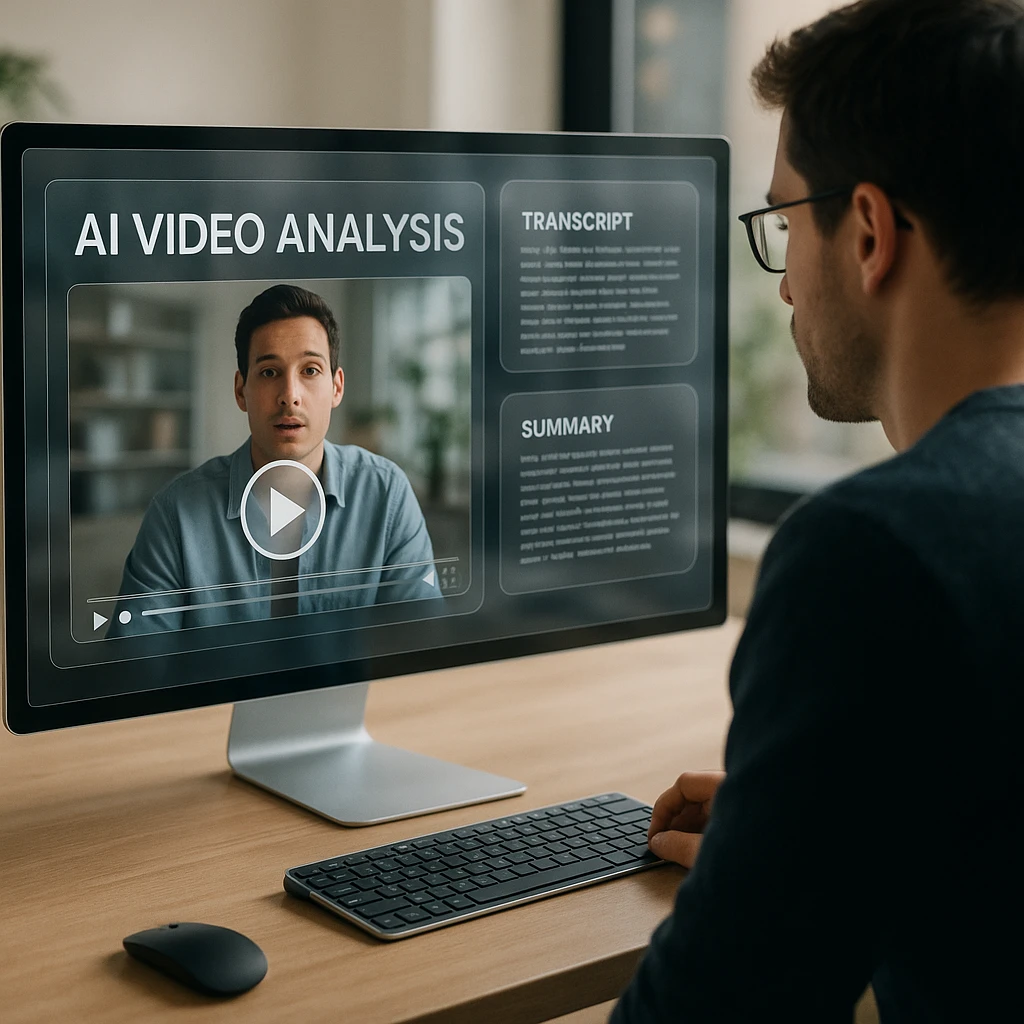
An AI video watcher takes the MP4, MOV, or link directly, runs the transcription and the visual analysis itself, and gives you a summary plus a question box aimed at the video, no FFmpeg, no frame budgeting, no format wall. ScreenApp’s free plan covers 2 transcriptions and 3 uploads so you can test it on a real video before paying. We compared the tools that can do this, ours included, in our roundup of AI tools that can watch videos.
The two approaches also stack. Let the video tool do the watching, export the transcript and summary, and hand those to Claude for the parts Claude is best at: rewriting for a different audience, comparing three videos against each other, or turning one recording into an article, a checklist, and a follow-up email. That split, dedicated tool for extraction, Claude for reasoning, beats either one alone. You can also remove the handover: ScreenApp has an MCP connector, so Claude reads the transcript and summary straight out of your library once you connect the two. No exporting, no pasting.
Claude vs a dedicated video analyzer
| Capability | Claude | Dedicated video analyzer |
|---|---|---|
| Direct MP4 or link upload | No | Yes |
| Automatic transcription | Needs another tool | Built in |
| Visual scene analysis | Only on frames you extract | Runs on the full video |
| Transcript summarization and reasoning | Excellent, large context | Good, fixed formats |
| Ask questions about the video | After preprocessing | Immediately after upload |
| Custom automation and repurposing | The best there is | Limited |
| Coding required | For anything automated | None |
The honest sorting rule: start from what you are holding. If you have a transcript, or you need reasoning, comparison, and repurposing, Claude is the right tool and a pleasure to use. If you have a video file and the question “what is in this,” a dedicated analyzer answers it in the time Claude takes to reject the upload. And this whole boundary is not unique to Claude: ChatGPT has the same no-video wall with different edges, which we mapped in can you upload video or audio to ChatGPT. If your question is about making videos rather than understanding them, that is the sibling article: can Claude create videos.
A few limits to keep in view regardless of route. Sampled frames miss brief events. Speech-to-text mangles names, and every summary inherits the transcript’s errors. A very long transcript can still crowd a context window. And a confident summary is not a verified one: for anything with stakes, check the claims against the actual recording before you forward them.
So, can Claude watch videos? No, and it is not close: no video formats, no audio input, no motion, first frame only even on a GIF. Can it analyze and summarize videos? Yes, as well as anything on the market, the moment you hand it the video’s contents as text and stills. Get the extraction from a tool built for it, give Claude the reasoning work, and you have the best version of both.