

A Video Downloader That Fits Why You Use Brave
People run Brave to keep their browsing to themselves. So the last thing you want for saving a video is an extension that reads every site you visit, or a downloader site that logs the URL you asked about. This tool fits the reason you chose Brave: you paste a link, the fetch goes from the source site straight to your device, and the video URL is not handed to a third-party server to sit in a log.
Brave is Chromium, so it can run Chrome downloader extensions. But installing one means granting broad read access to your browsing, which rather defeats the point. A paste-URL web tool sees only the single link you give it. Nothing else.
- Works in Brave on desktop and Android
- No extension, and the URL is not routed through a ScreenApp account
- Rebuilds streamed HLS video into one MP4, audio included
- Takes YouTube, Vimeo, and direct links, plus a batch at once
- Public web video the site will serve, not DRM-protected streaming
Same tool framed for Chrome on the Chrome video downloader, if you want the mechanics explained there.
Brave Shields, and Why the Download Still Needs This
Brave Shields blocks ads and trackers at the browser level, which is great for browsing and occasionally awkward for video. Shields can break a site’s player or block the scripts an on-page downloader would use, so the download button you hoped for either never loads or does nothing. Pasting the link into a tool that fetches the file directly steps around a broken player entirely.
And the universal reason underneath it: most video is streamed as HLS, an .m3u8 playlist split into hundreds of chunks, with the player pointing at a temporary blob: address. There is no single file for right-click Save As to grab. The tool reads the playlist, pulls the chunks, and stitches one MP4. Brave will not do that reassembly itself, Shields or no Shields.
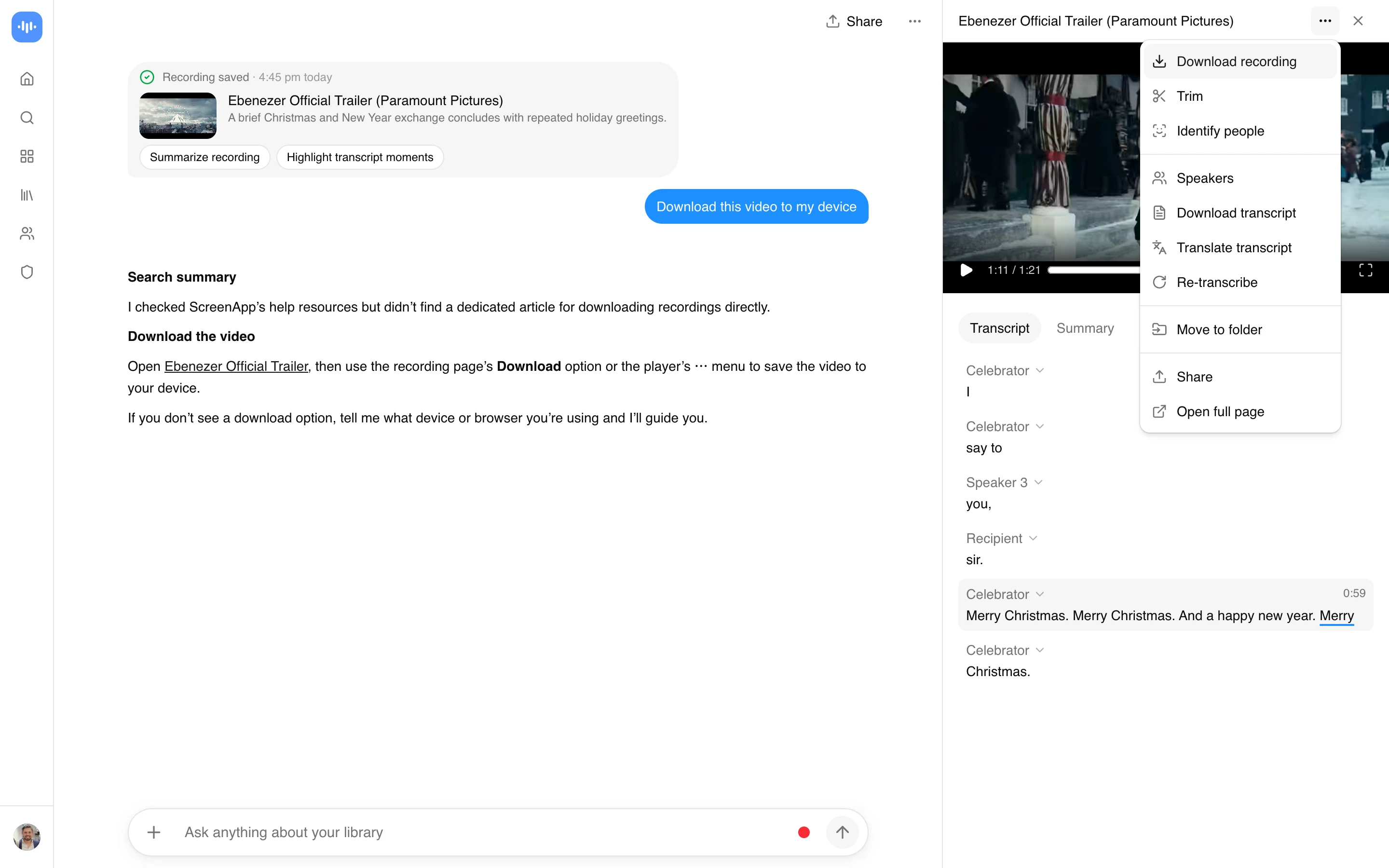
Worth being exact about what happens: the import runs on ScreenApp’s servers. You paste the link, ScreenApp fetches the video there, and you download it from your library, so the video and the source URL do pass through your ScreenApp account. It is not a browser-local download.
Paste, Download, Done
- In Brave, copy the video or page URL from the address bar. On Brave mobile, use the share menu and copy the link.
- Paste it into the field on this page.
- Download. The MP4 saves to your Downloads.
If a video will not load at all, try lowering Shields for that one site (the lion icon in the address bar), since aggressive blocking sometimes stops the page from serving the stream in the first place. That is a Brave setting, not the tool.
Do More Than Save It
The download is step one. The same import can hand the video to AI, which is where a saved talk or research clip stops being just a file. Get a transcript and a written summary with the AI video summarizer, ask the video questions with timestamped answers using the AI video watcher, run scene and content detection with the video analyzer, or turn it into a formatted write-up with video to document. The import runs on ScreenApp’s servers, not on this page. Importing and the transcript are free; the free plan covers 2 transcriptions of recordings up to 45 minutes each, and downloading the MP4 needs a paid plan, from $19/month billed annually on Pro.
Who Downloads Video in Brave
Privacy-first users, by definition, since that is who Brave attracts. They want the file without an extension reading their browsing and without a downloader site keeping a record of the URL. The browser-local fetch is the whole reason this fits them.
Brave mobile users on Android, where “how to download videos in Brave browser” is a common question and extensions are not really an option. And people who tried a download button that Brave Shields quietly broke, and needed a route that does not depend on the site’s own player working.
Privacy and Copyright
Download only web video you have the right to keep: your own content, public video you are authorized to use, or material in the public domain. Saving copyrighted video without permission can infringe the owner’s rights and breach the source site’s terms, and that responsibility is yours. DRM-protected streaming (Netflix, Disney+, paid subscription video) is off-limits in Brave or any browser, because it is encrypted for exactly that reason.
On privacy, the import runs on ScreenApp’s servers: the link is sent to your ScreenApp account, the video is fetched there, and you download it from your library. So the video does pass through your ScreenApp account, and it, along with any transcript or summary you generate from it, is covered by ScreenApp’s privacy policy.