Board Meeting Minutes Template: Free Word, PDF and Example


On this page
Board meeting minutes are the official written record of a board meeting: who attended, whether there was a quorum, what was decided, and who has to do what next. Below are 34 free templates you can download and edit in Word or as a PDF, with no signup, covering board minutes, committees, nonprofits, HOAs, agendas, resolutions, memos and reports.
We make ScreenApp, a recording and transcription tool. We don’t sell a board portal, and you don’t need our product to use this form. Our section on recording may surprise you, coming from a company that sells recording software.
Free Board Minutes Templates
All 34 templates are free to download with no signup or email. Edit the Word file, or print the PDF. Word files also open in Google Docs and Apple Pages, and blue text in brackets marks what to replace. Pick a category, then open a preview to read the whole page.
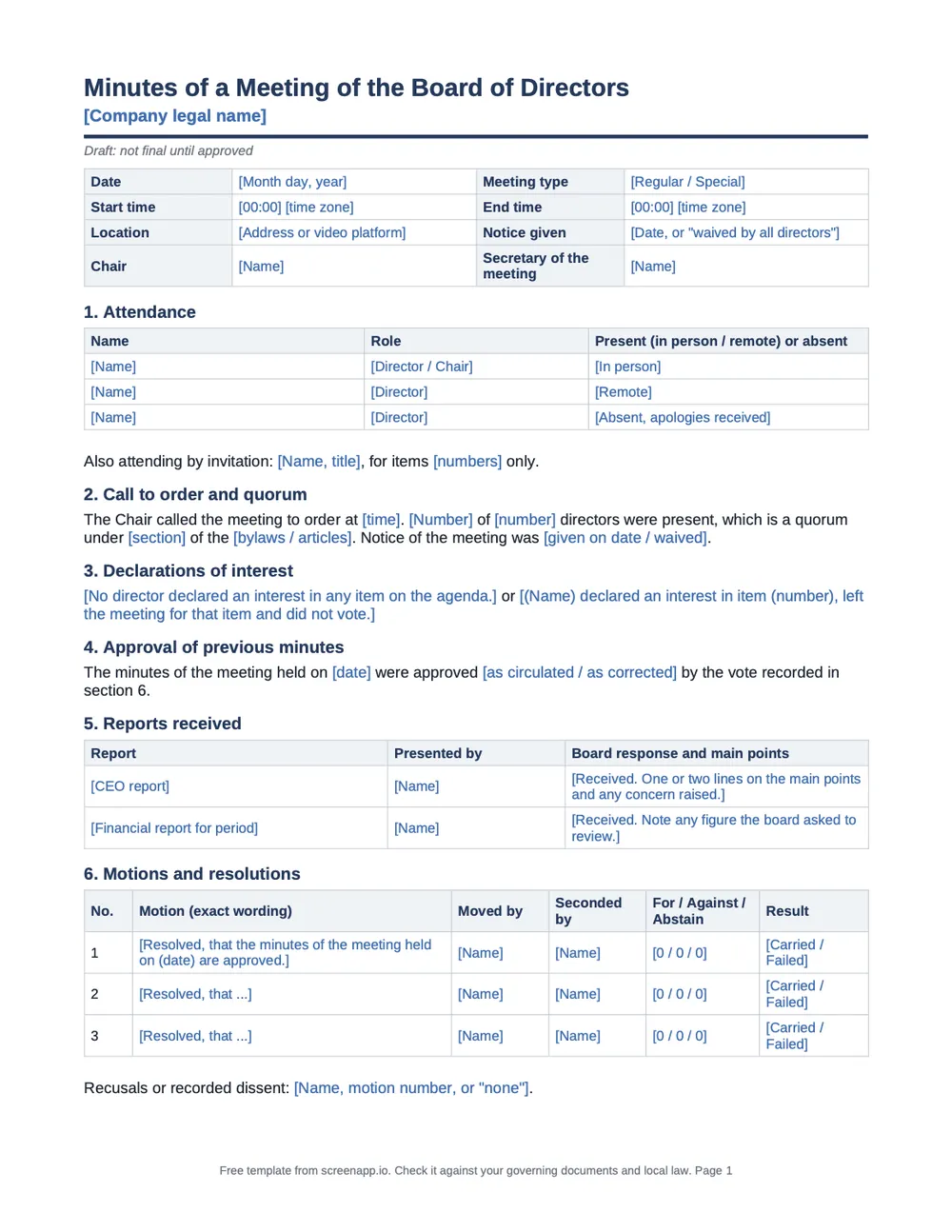
Corporate Board Minutes
The full form: quorum, conflicts, motions, votes and executive session.
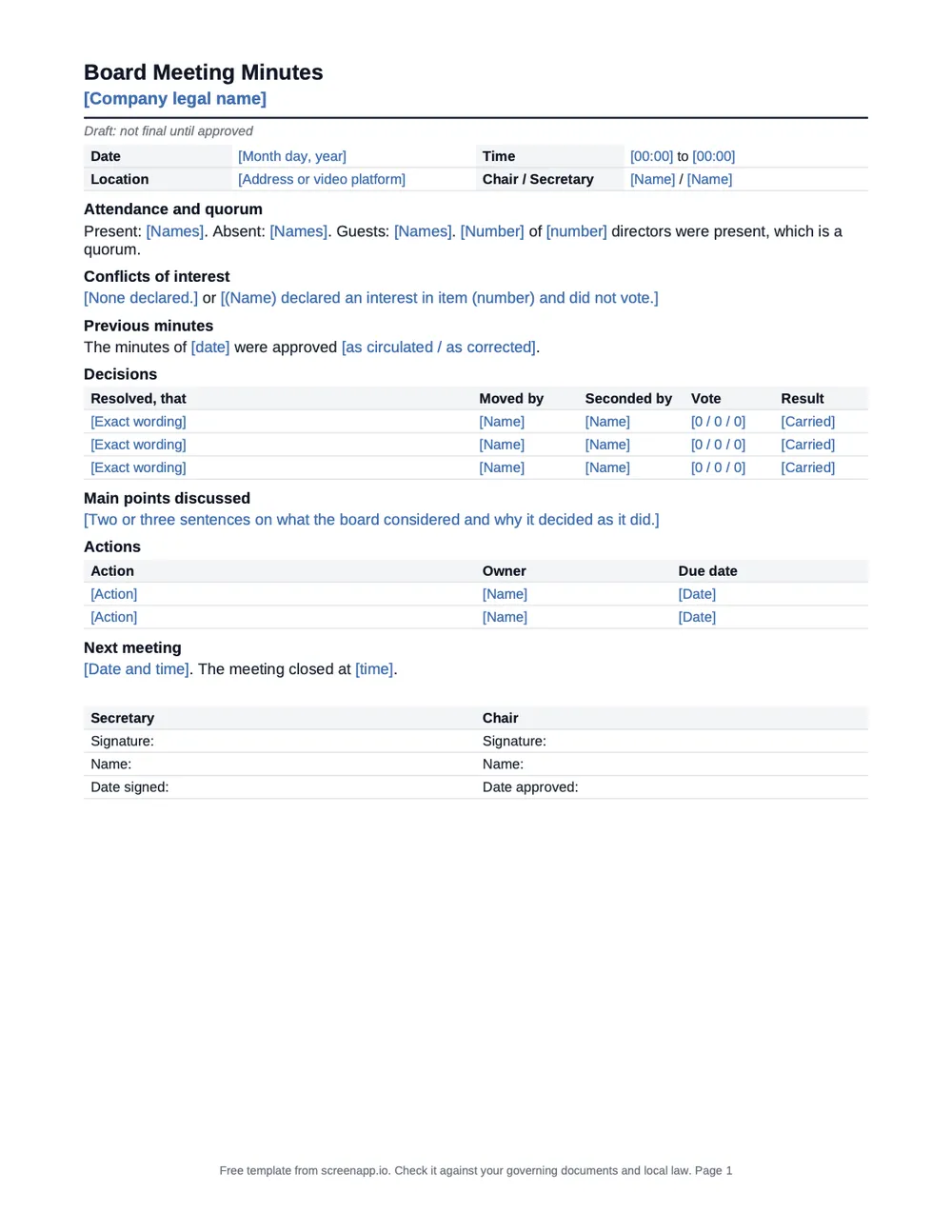
Simple One-Page Minutes
Decisions and actions on one page, for boards that meet informally.
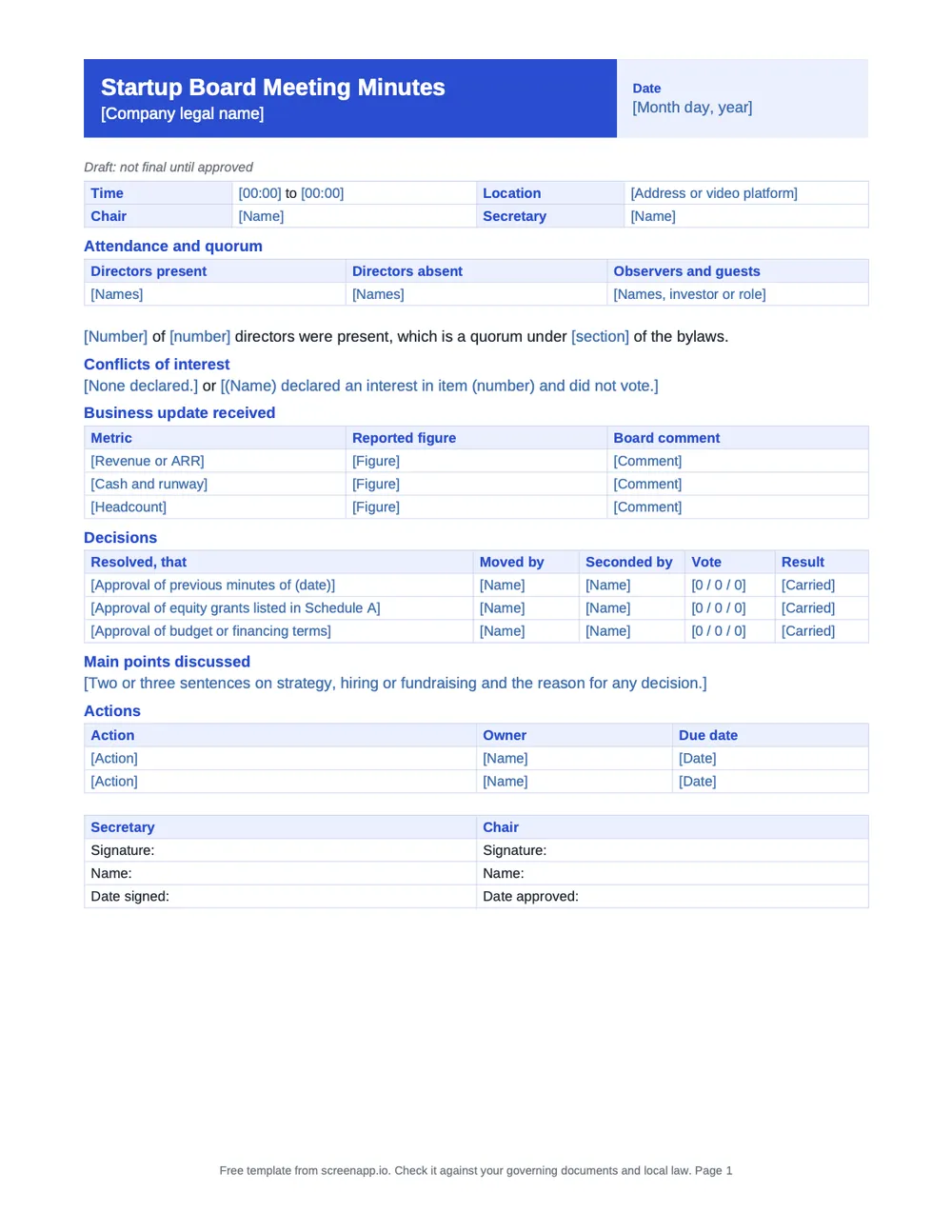
Startup Board Minutes
Adds business metrics, cash runway and equity grant approvals.
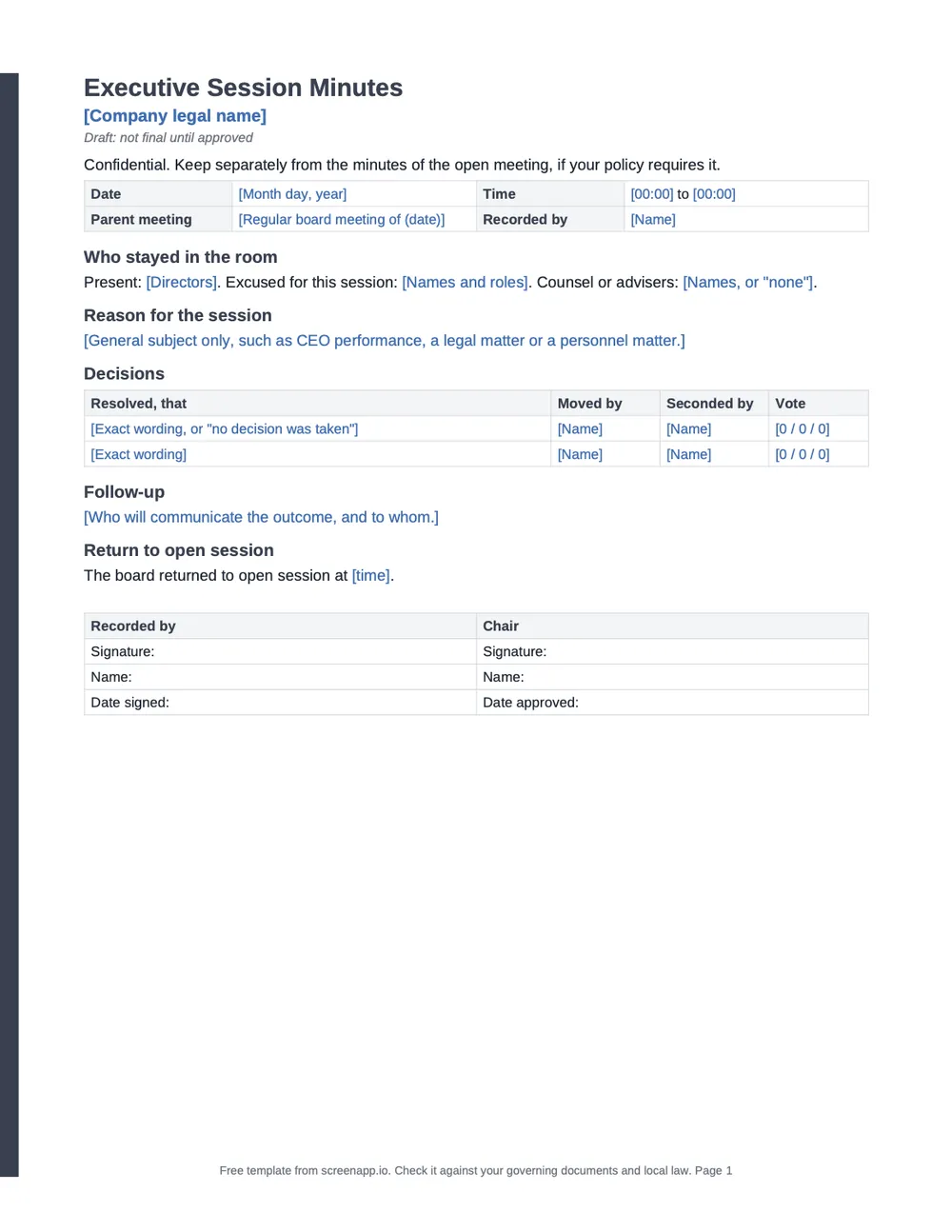
Executive Session Minutes
Records who stayed, the general subject and any decision, without the discussion.
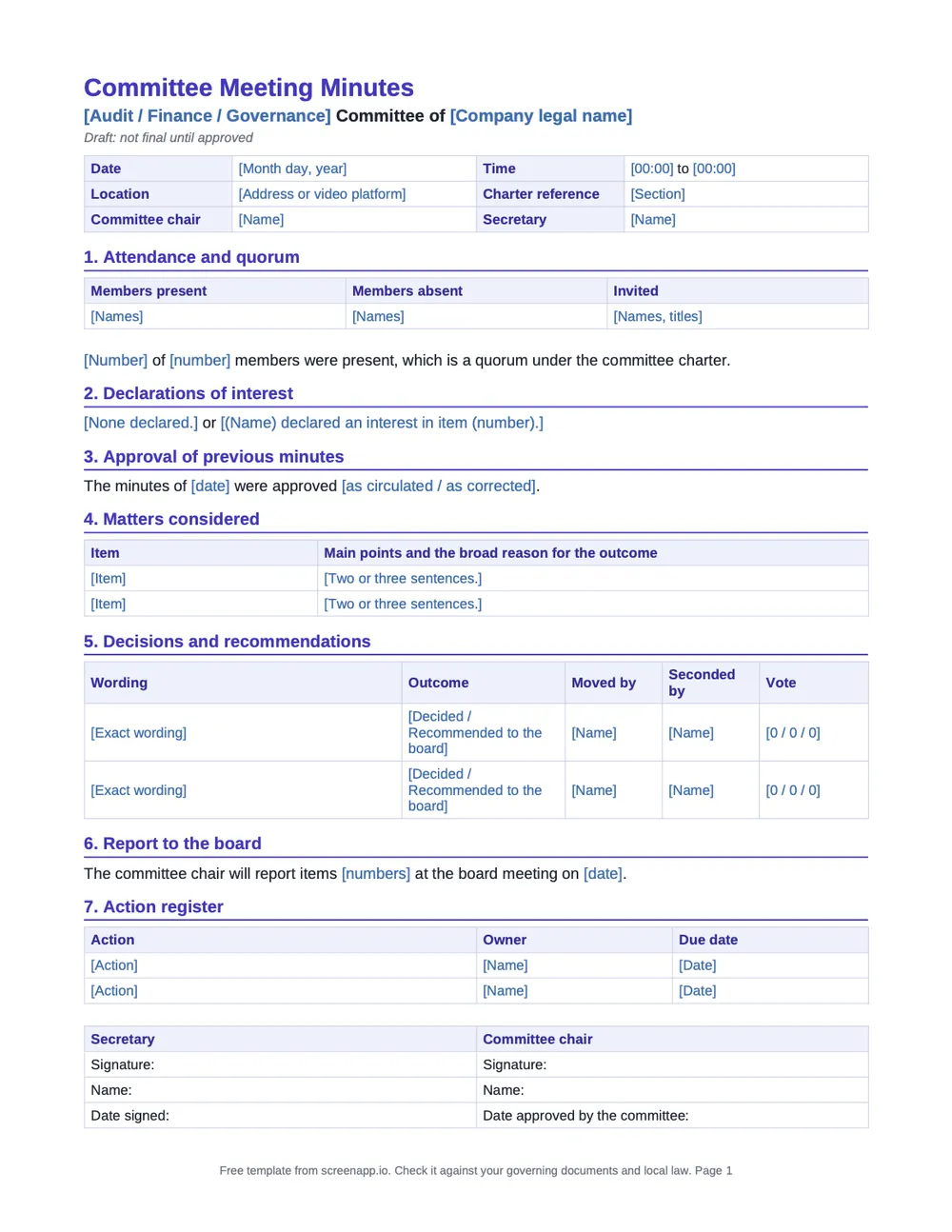
Committee Meeting Minutes
Separates what the committee decided from what it recommends to the board.
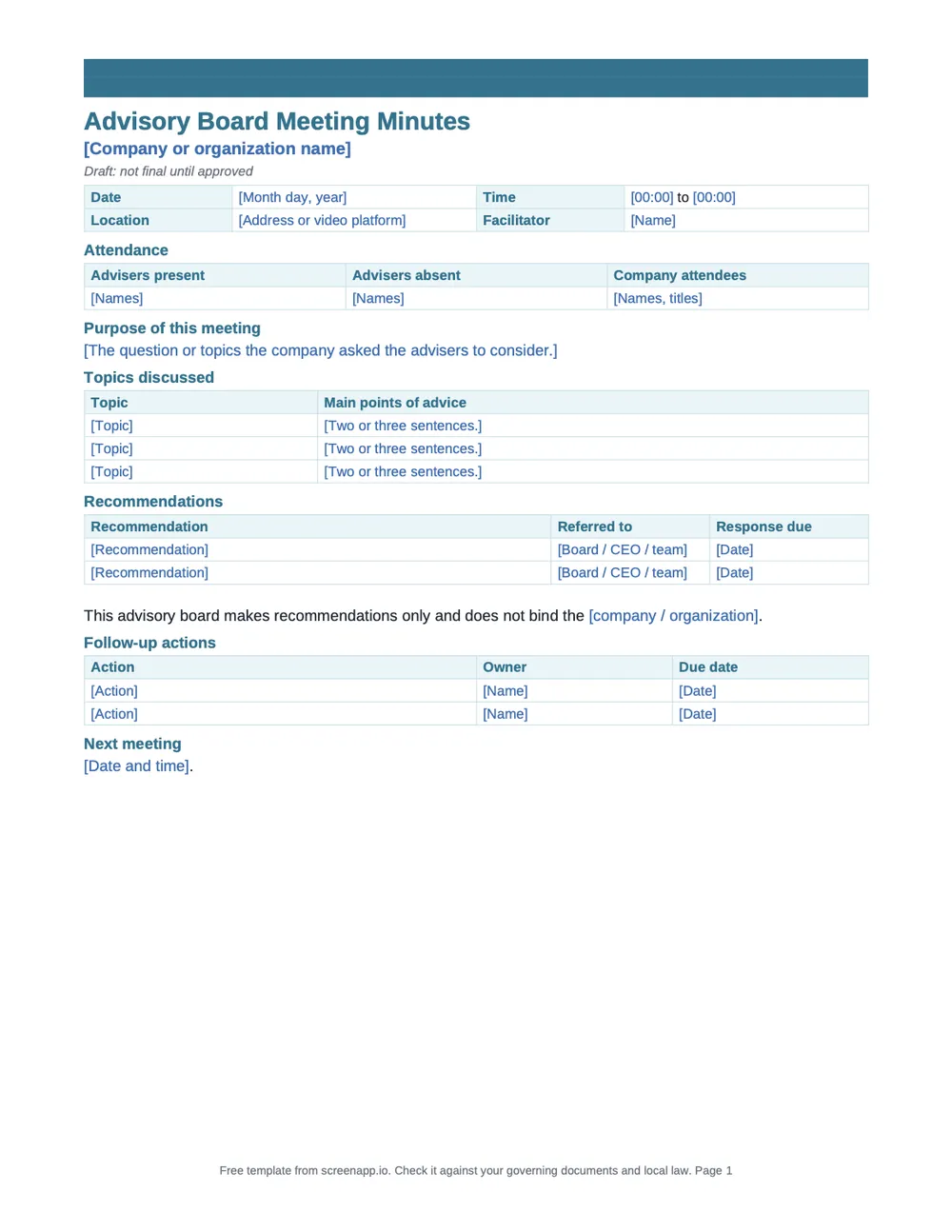
Advisory Board Minutes
Captures advice and recommendations, with no binding votes.
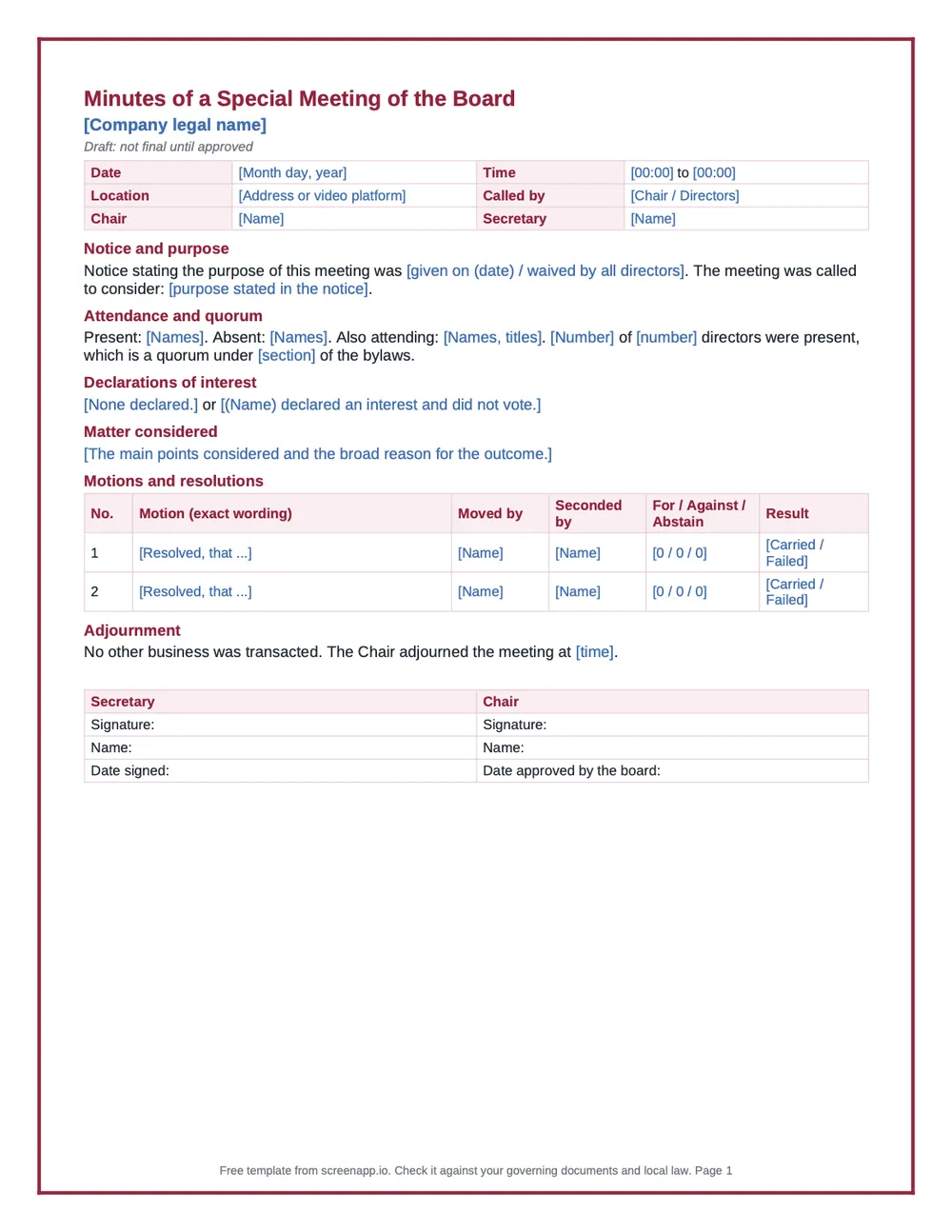
Special Board Meeting Minutes
Starts with the notice and the purpose the meeting was called for.
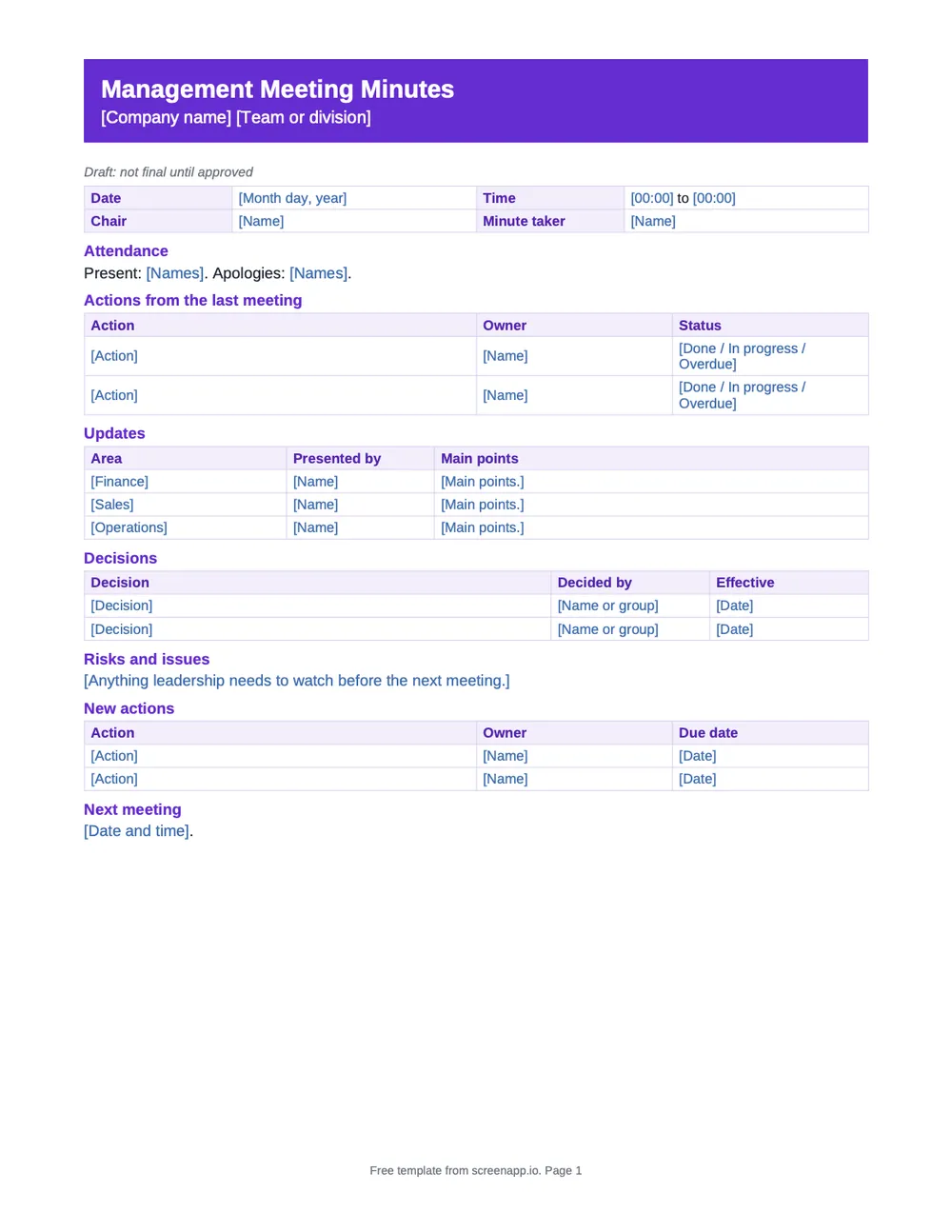
Management Meeting Minutes
Team updates, decisions, risks and carried-over actions.
Nonprofit Board Minutes
Conflict of interest disclosures, treasurer report and a Form 990 date line.
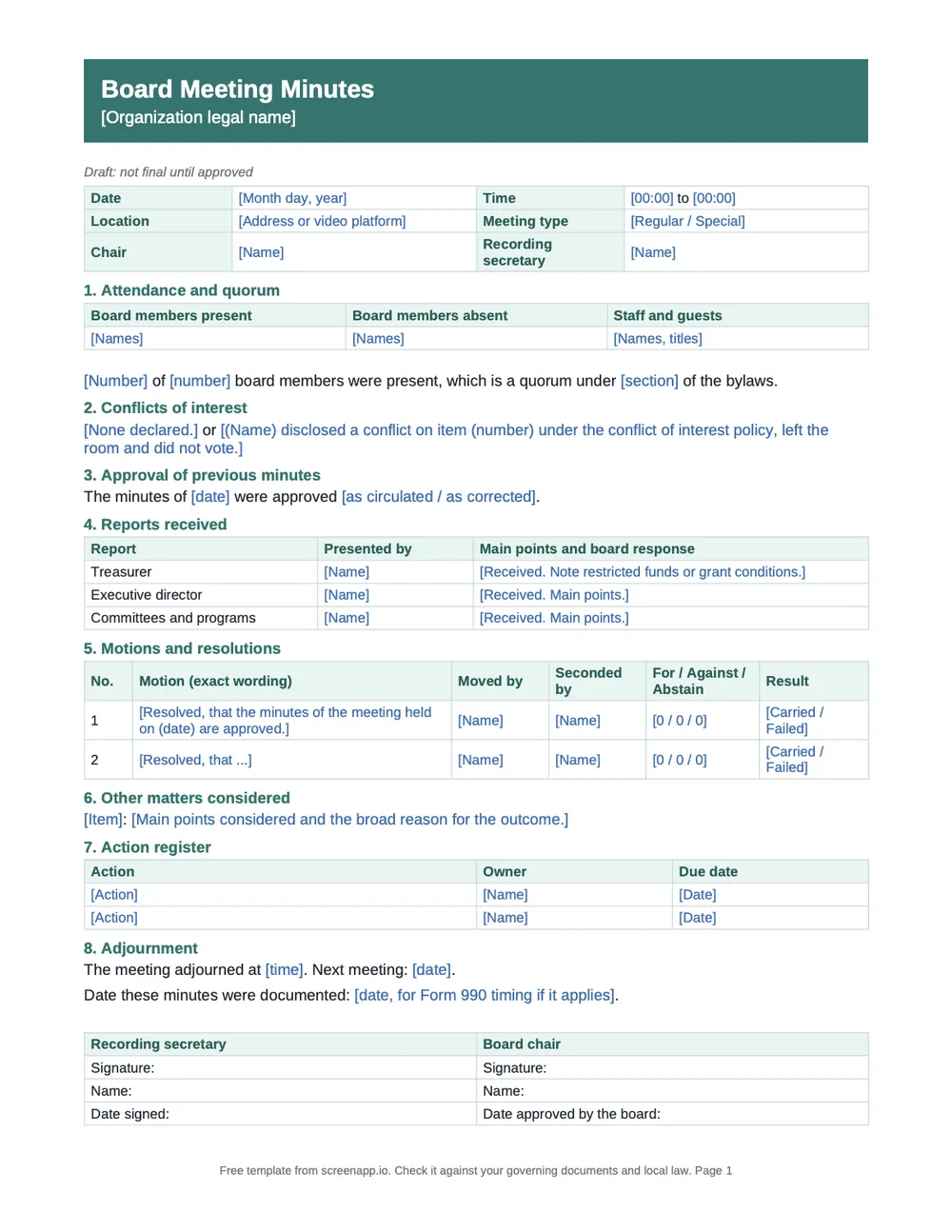
HOA Board Meeting Minutes
Homeowner forum, manager and architectural reports, and a closed session.
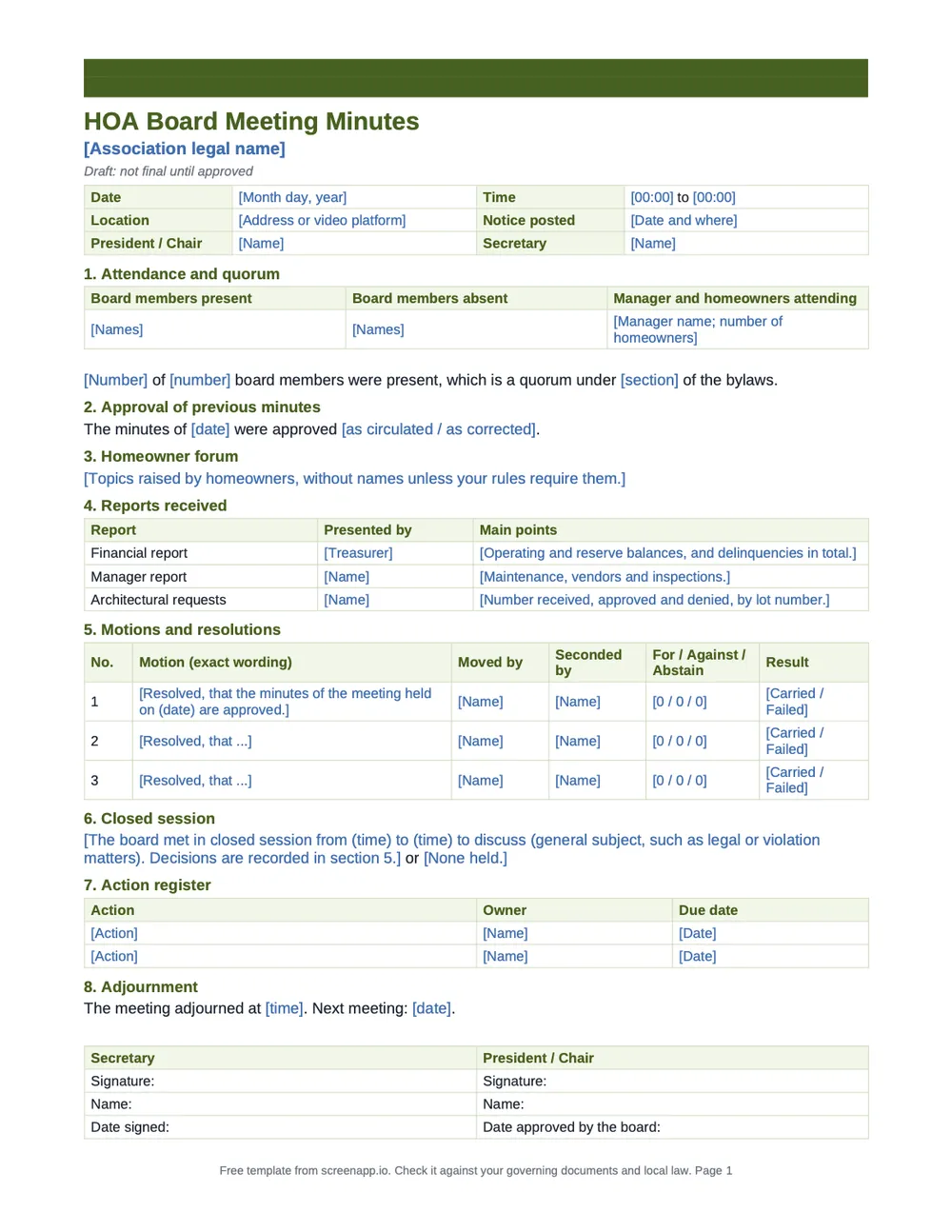
Annual General Meeting Minutes
Member attendance, proxies, director elections and resolutions.
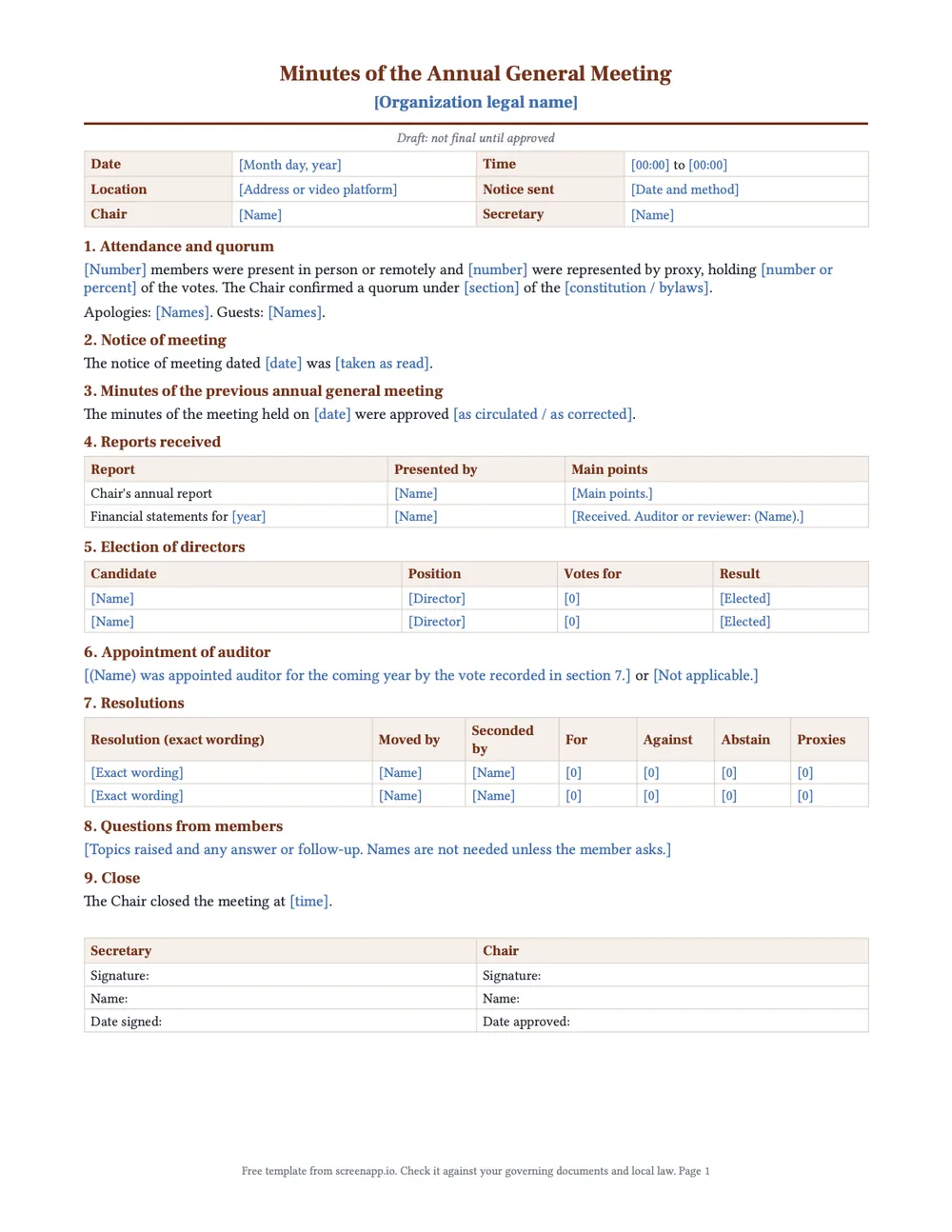
Annual General Meeting Agenda
The usual order of business, from quorum to election of directors.
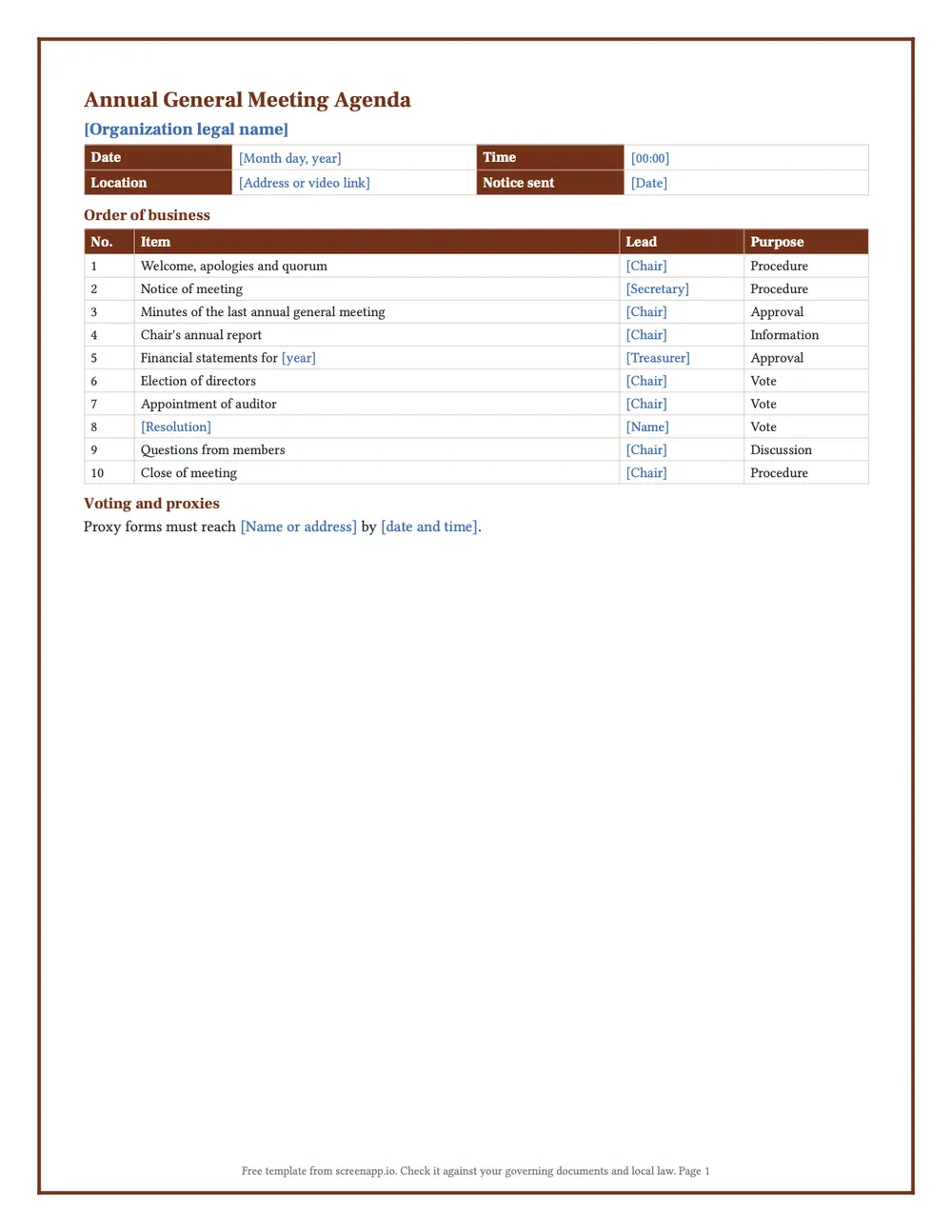
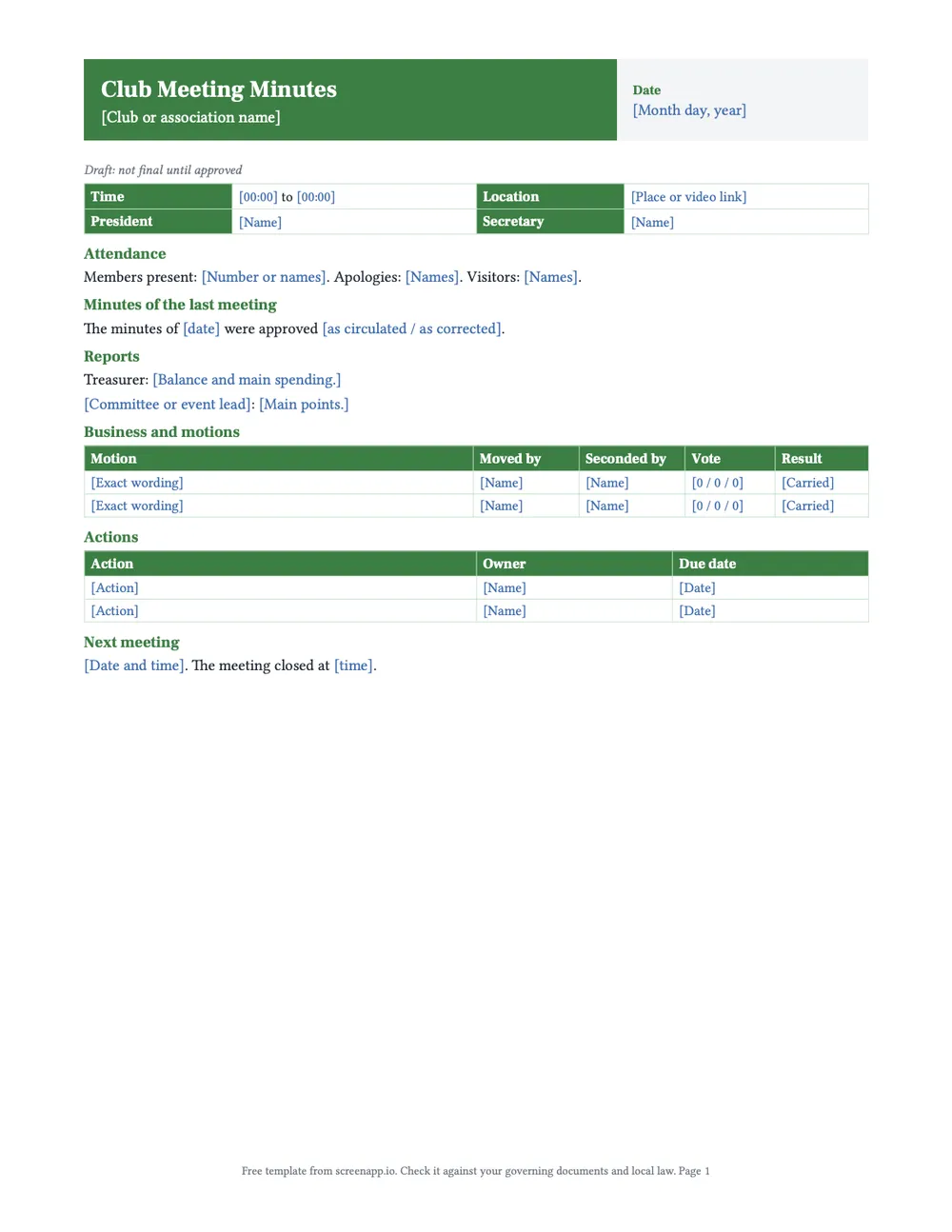
Club Meeting Minutes
A short form for reports, motions and actions at a member meeting.
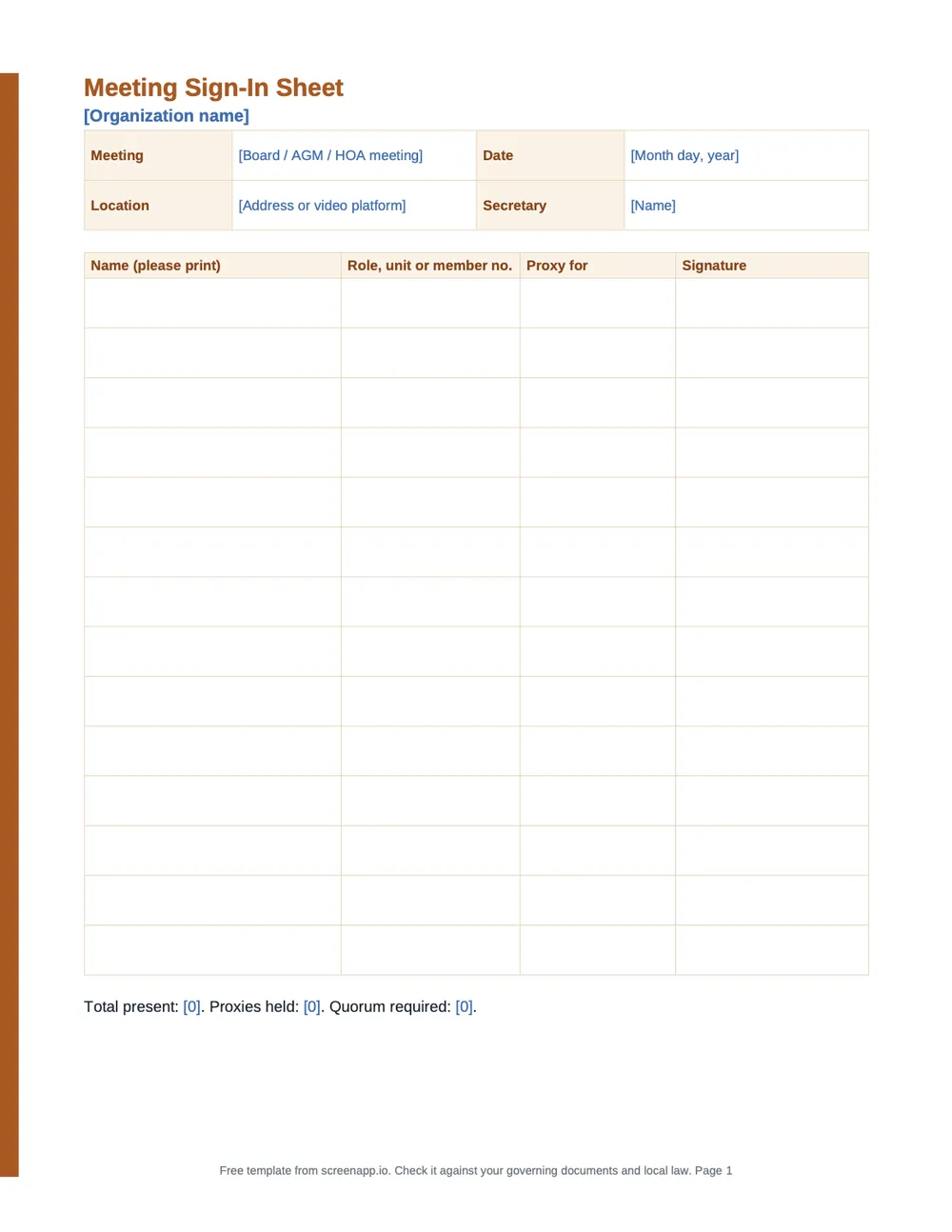
Meeting Sign-In Sheet
A printable sheet with a proxy column and a quorum count.
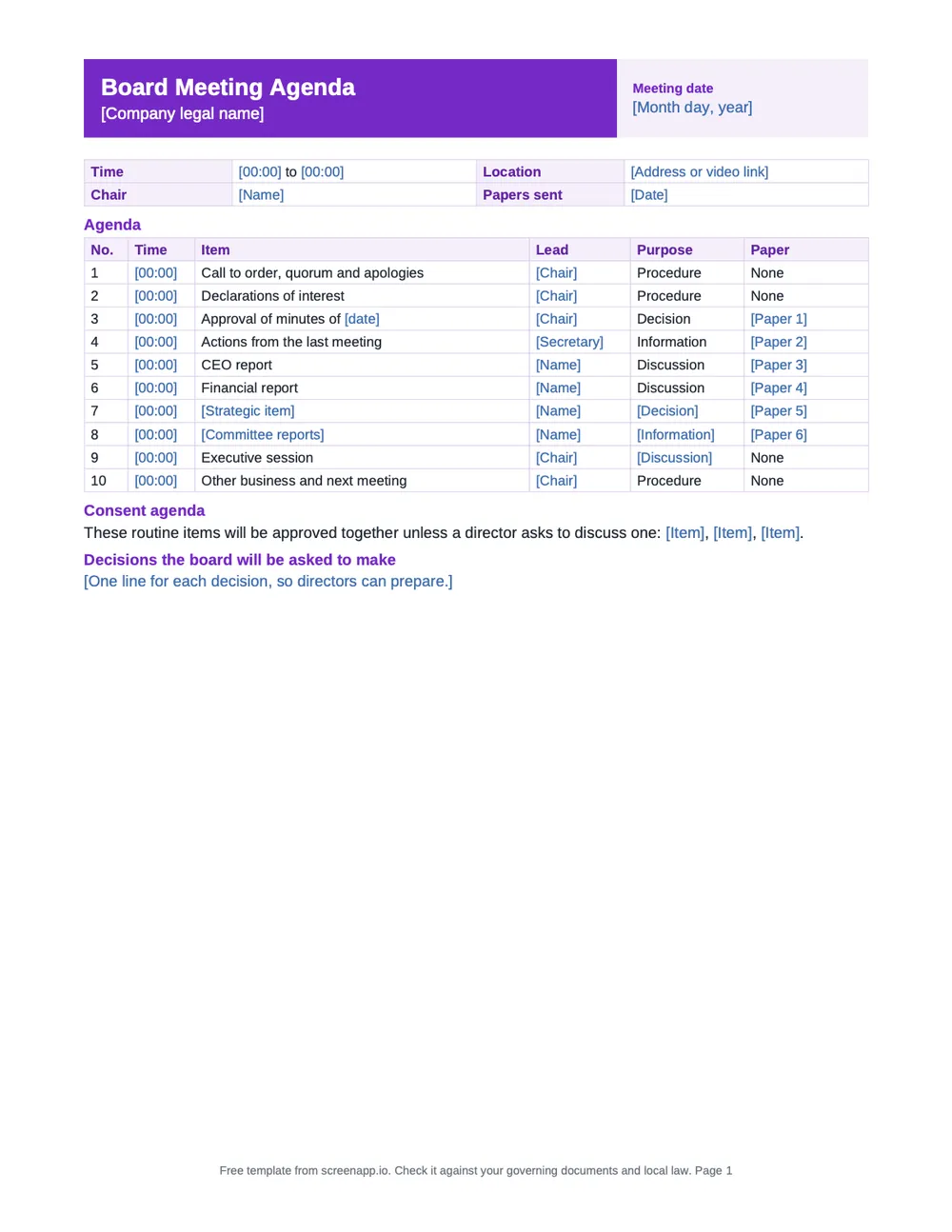
Board Meeting Agenda
Timed items marked for decision, discussion or information, plus a consent agenda.
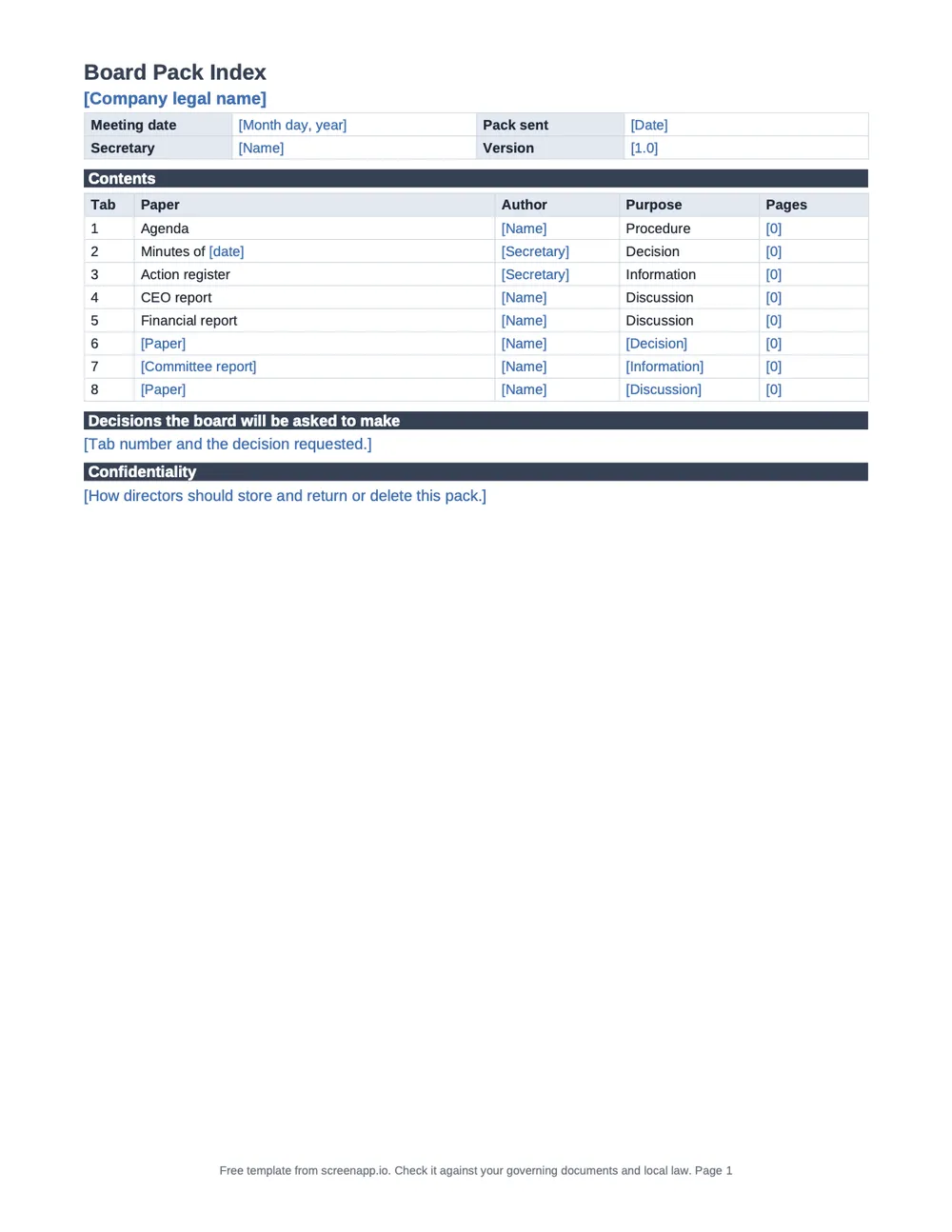
Board Pack Index
A contents page for the pack, with the author and purpose of each paper.
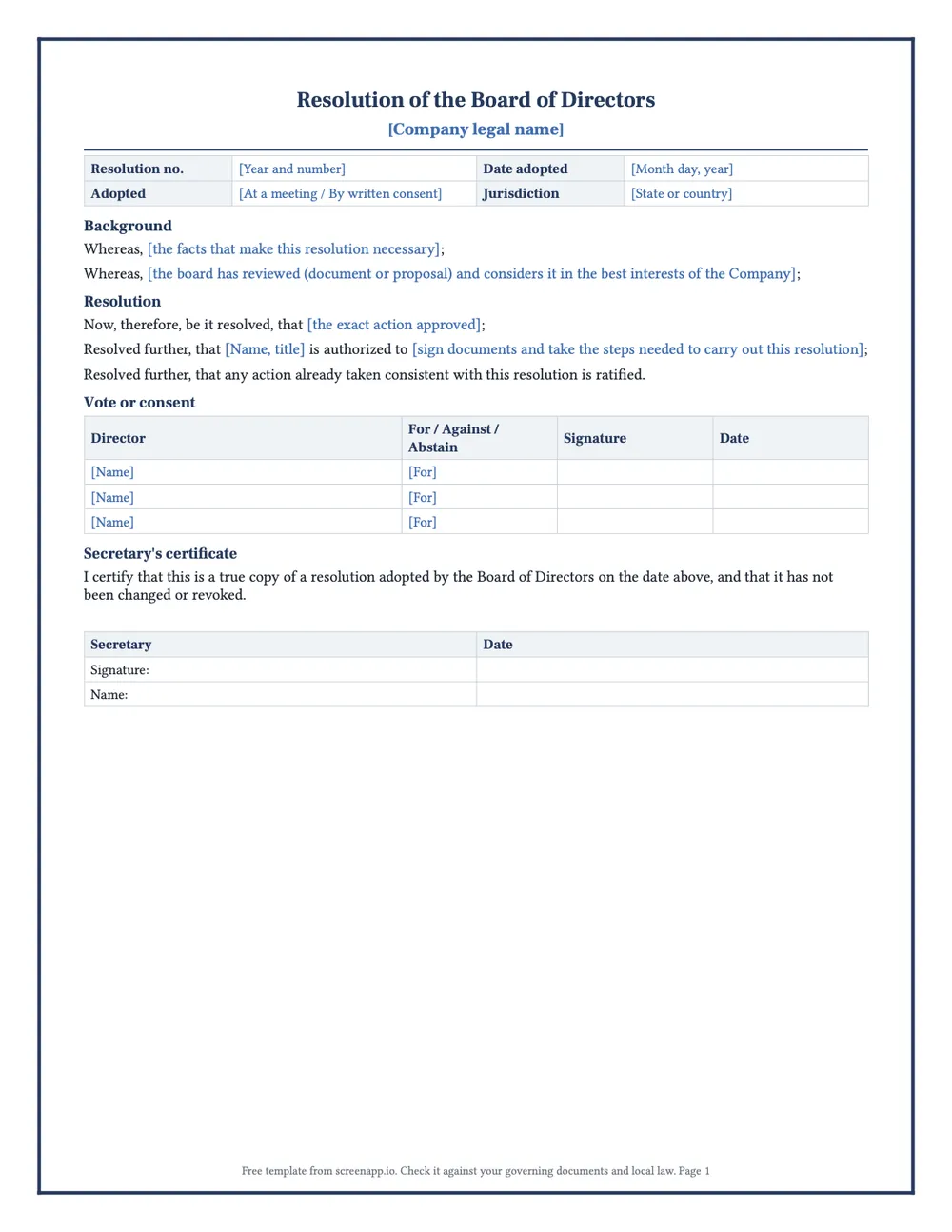
Board Resolution
Whereas and resolved wording, director votes and a secretary's certificate.
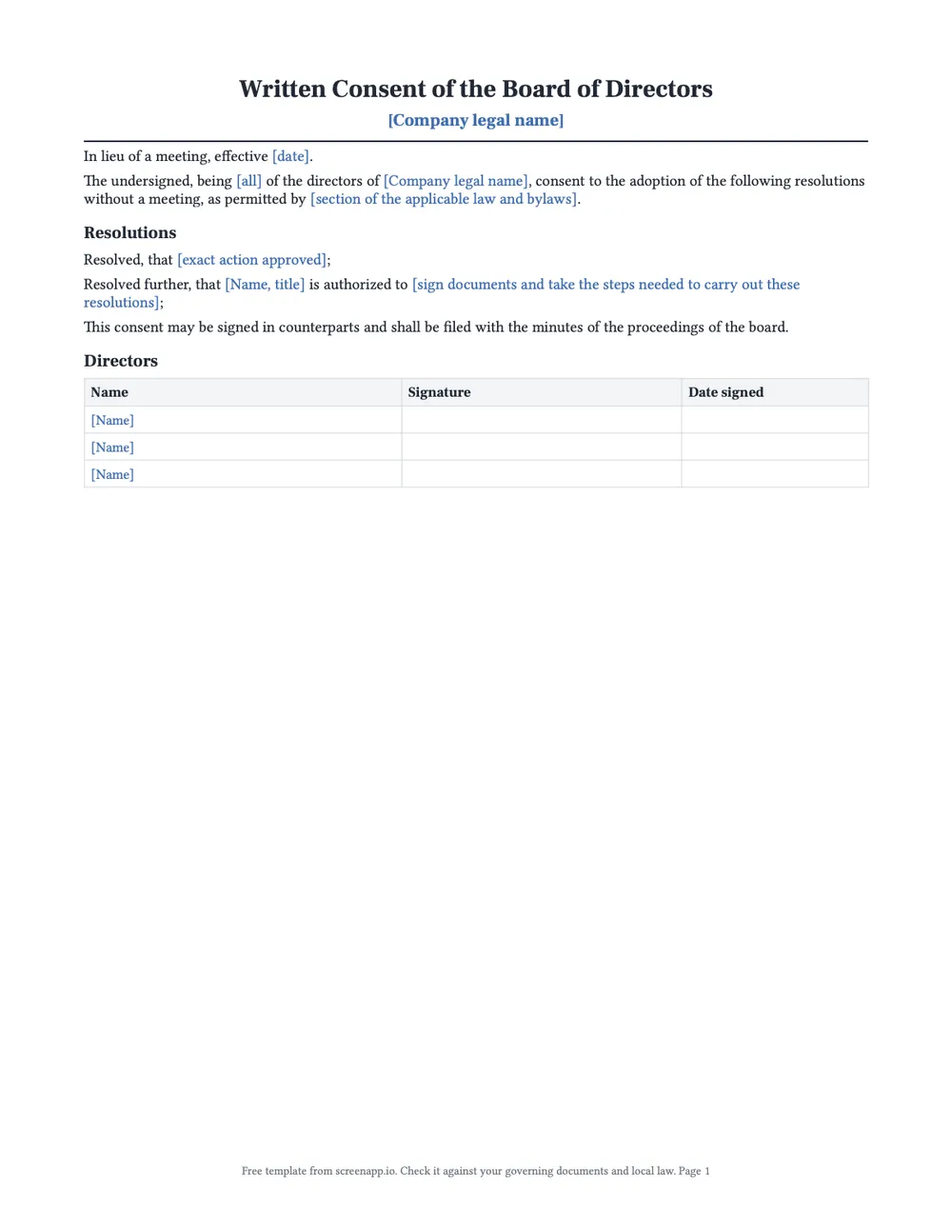
Written Consent of Directors
Lets directors approve resolutions by signature, without holding a meeting.
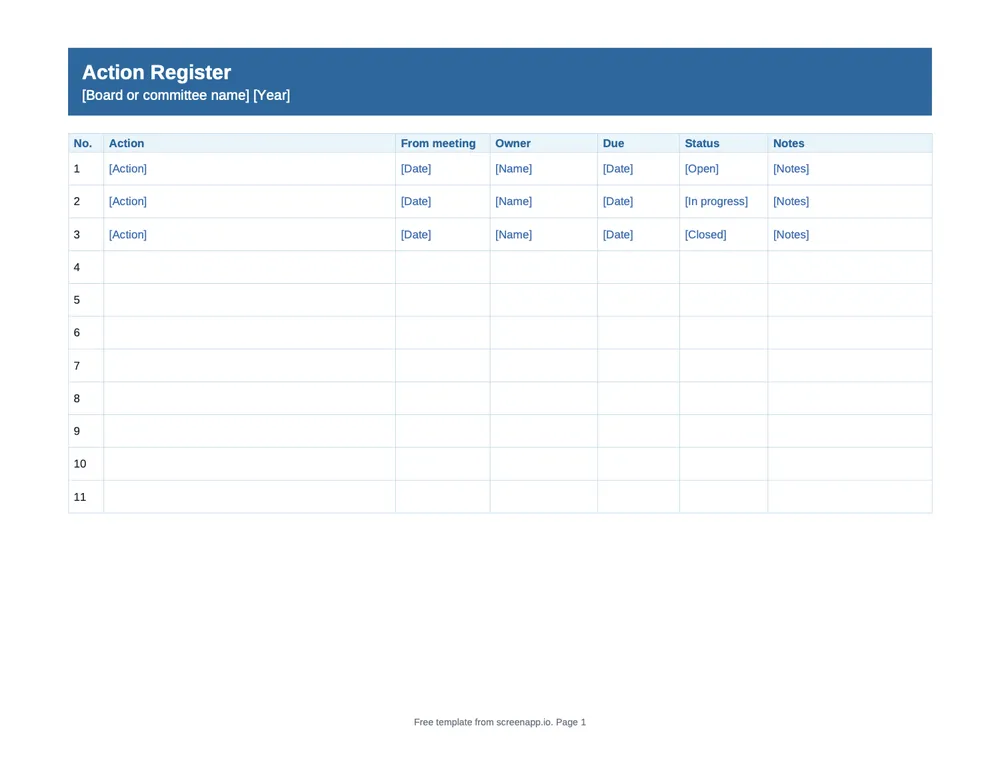
Action Register
A landscape tracker for owners, due dates and status across meetings.
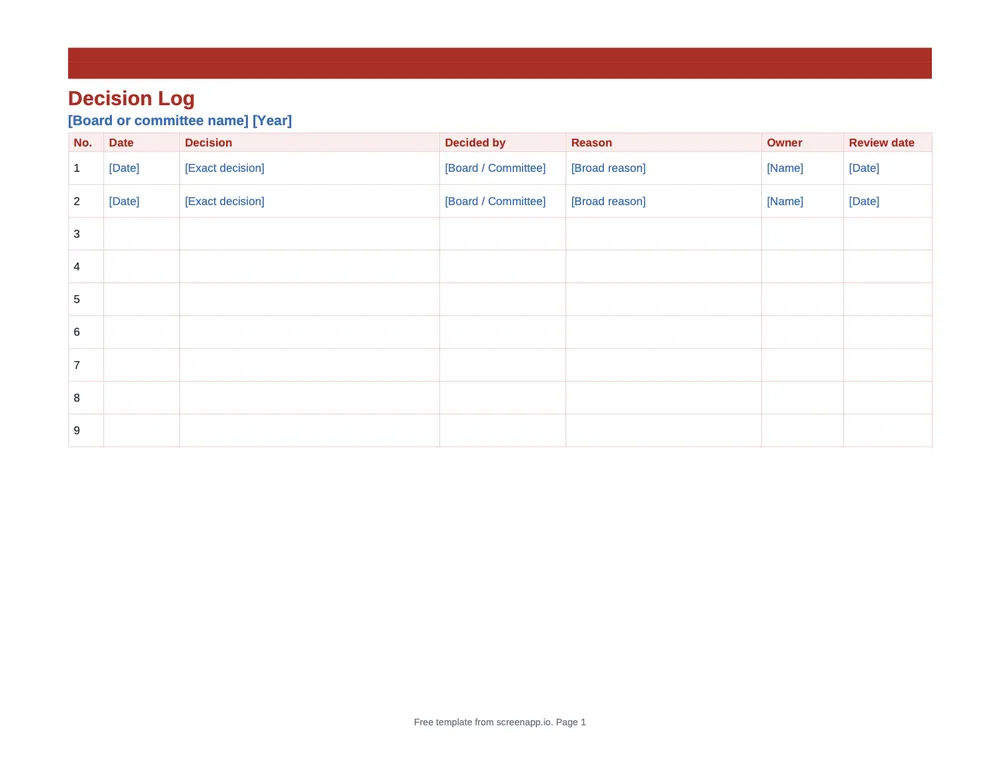
Decision Log
One running list of what was decided, by whom, why and when to review it.
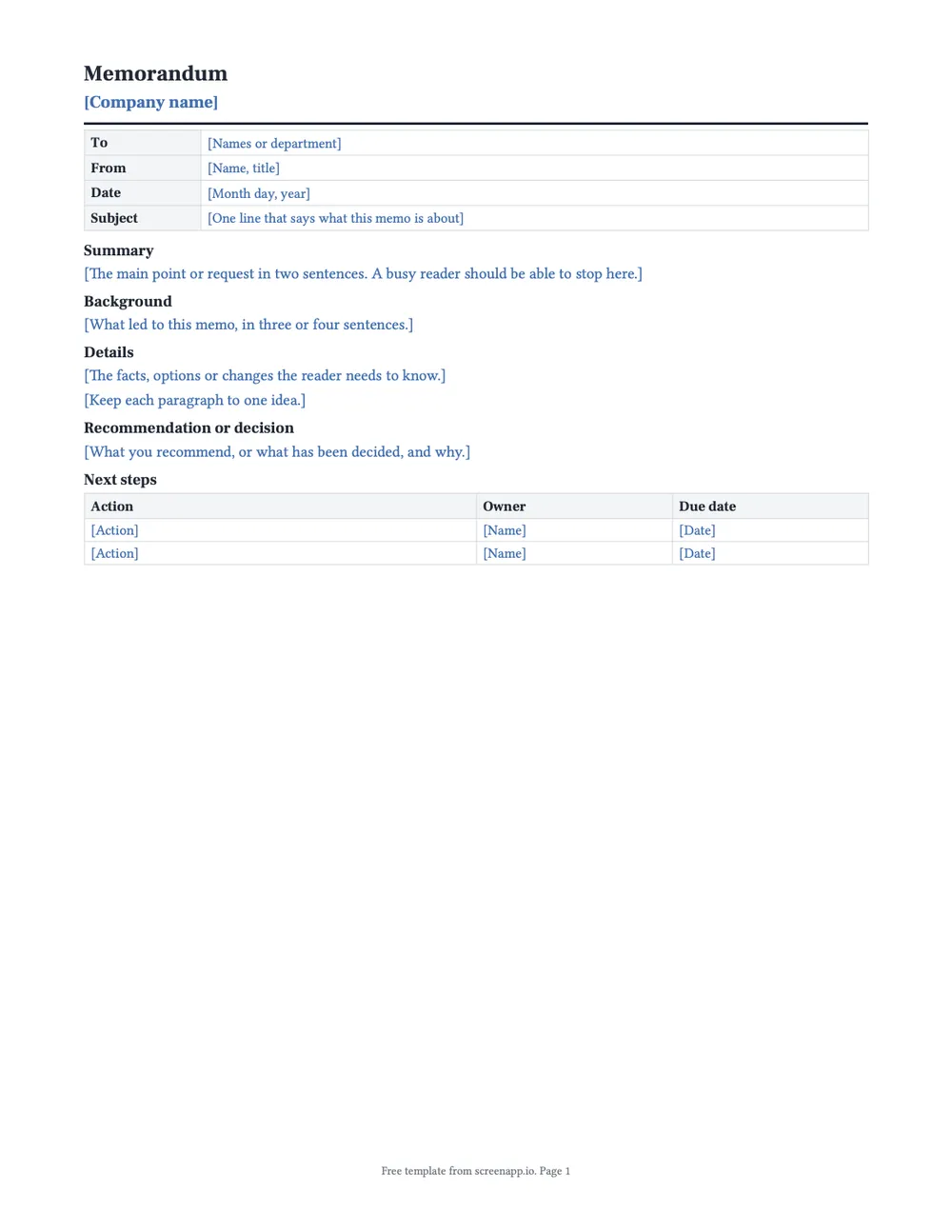
Business Memo
A standard memo layout that puts the main point first.
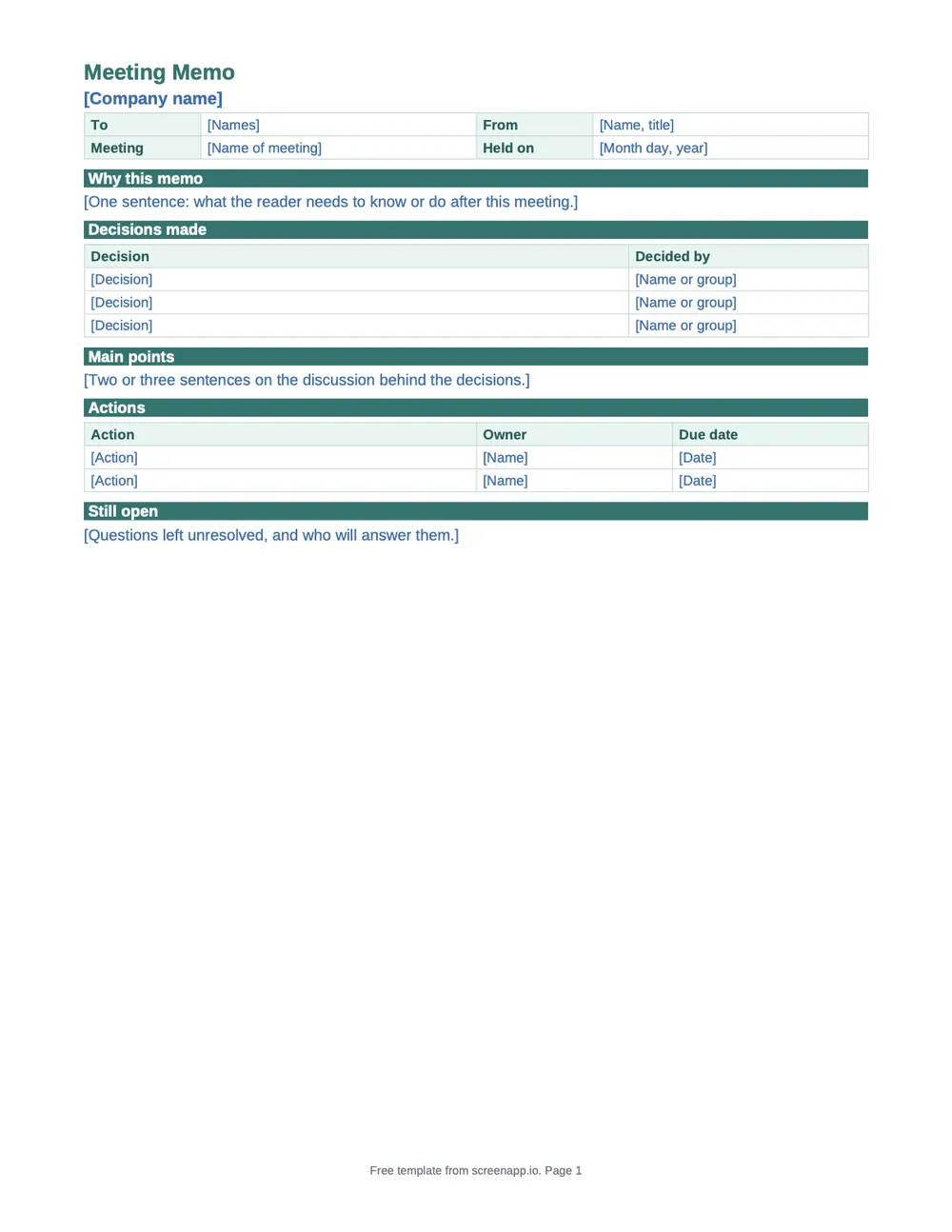
Meeting Memo
Decisions and owners for people who need them before the minutes are approved.
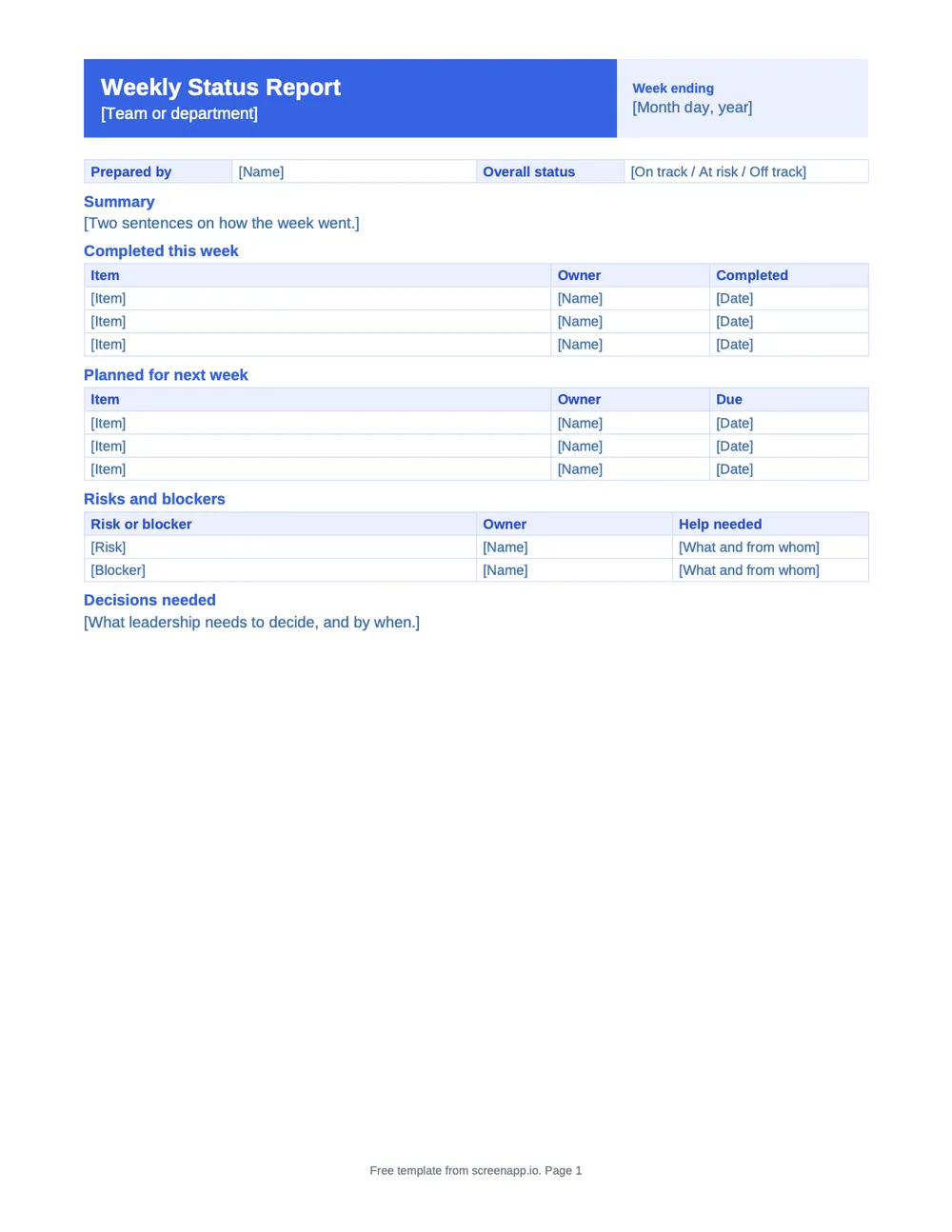
Weekly Status Report
Work completed, work planned, risks and decisions needed.
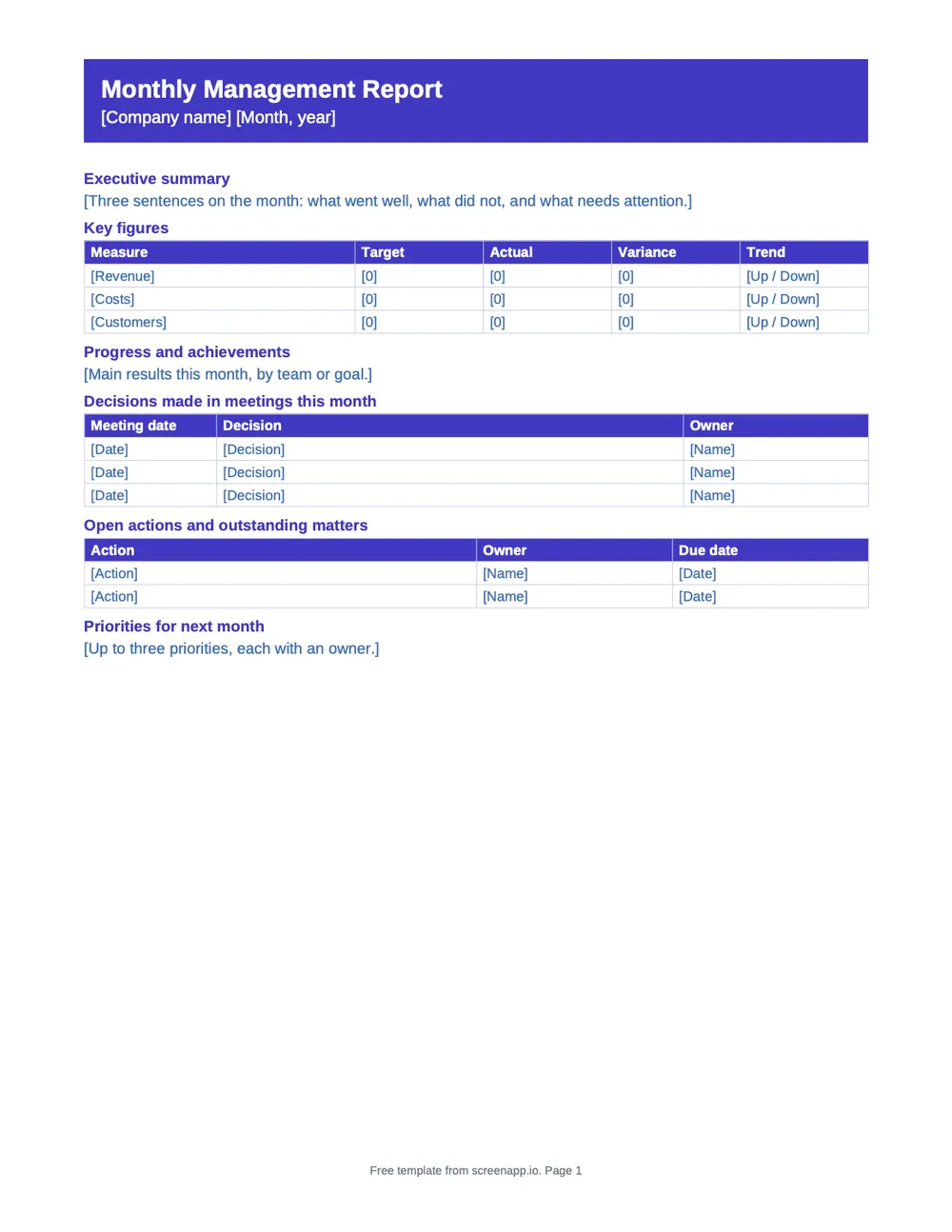
Monthly Management Report
Key figures, decisions across the month and priorities for the next.
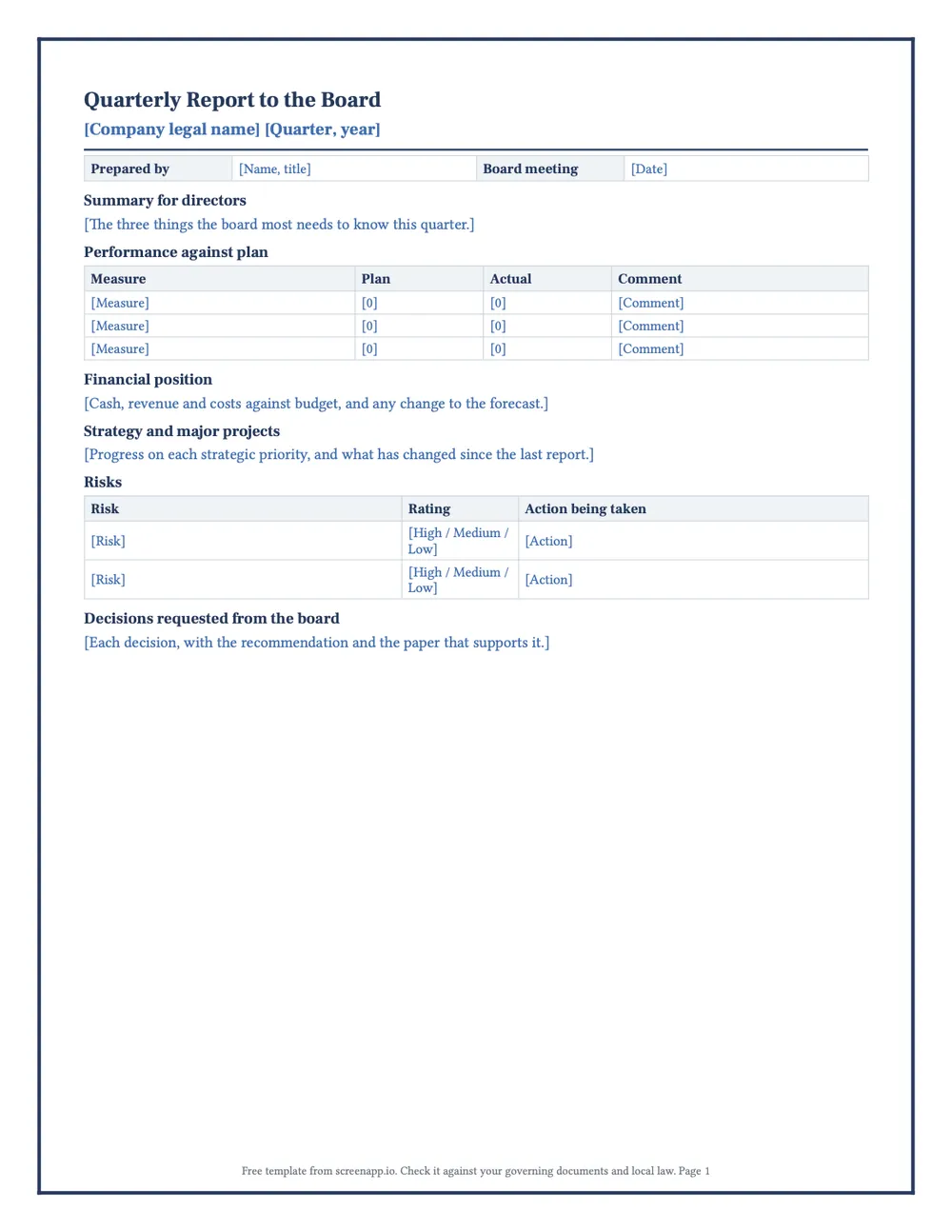
Quarterly Board Report
Performance against plan, risks and the decisions requested from the board.
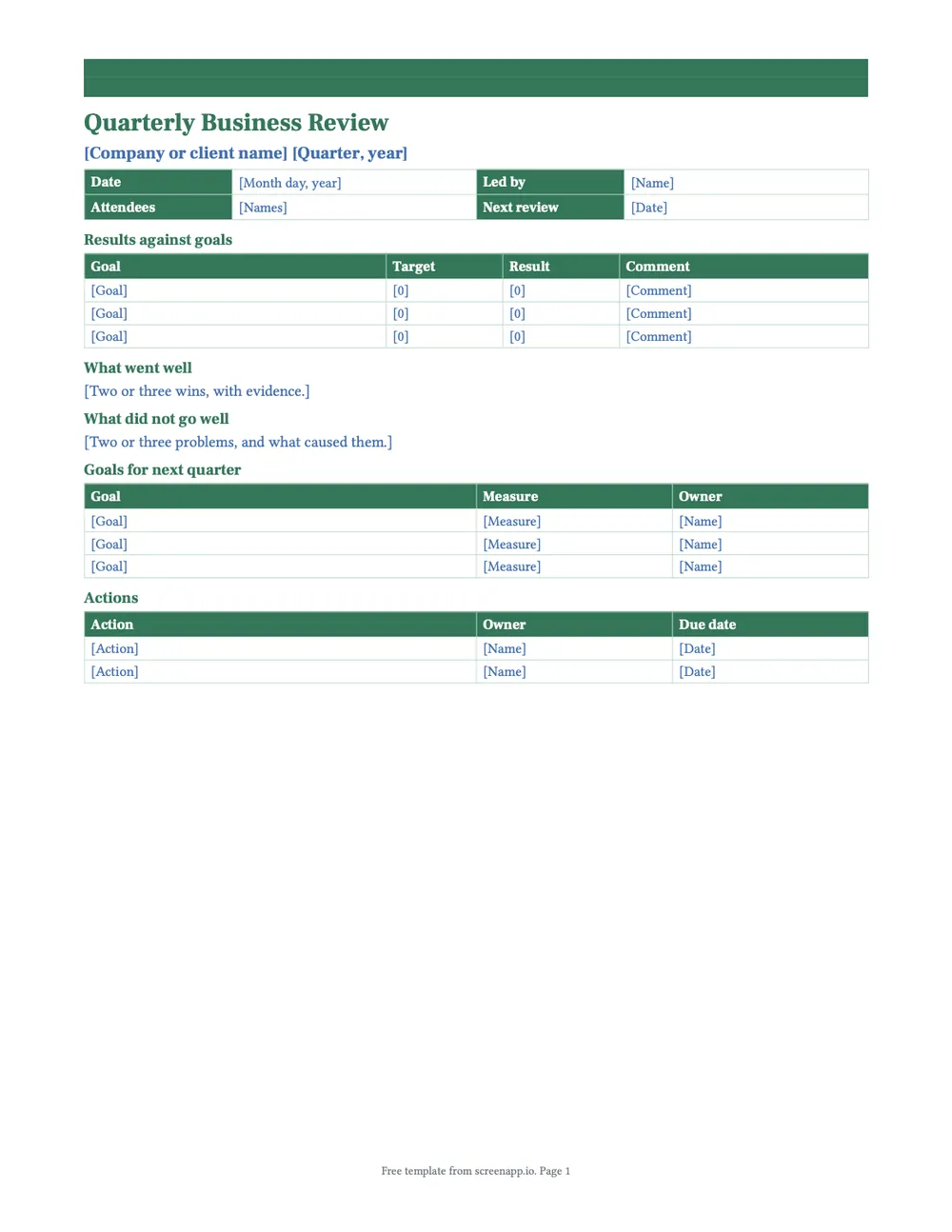
Quarterly Business Review
Results against goals, what worked, and goals for next quarter.
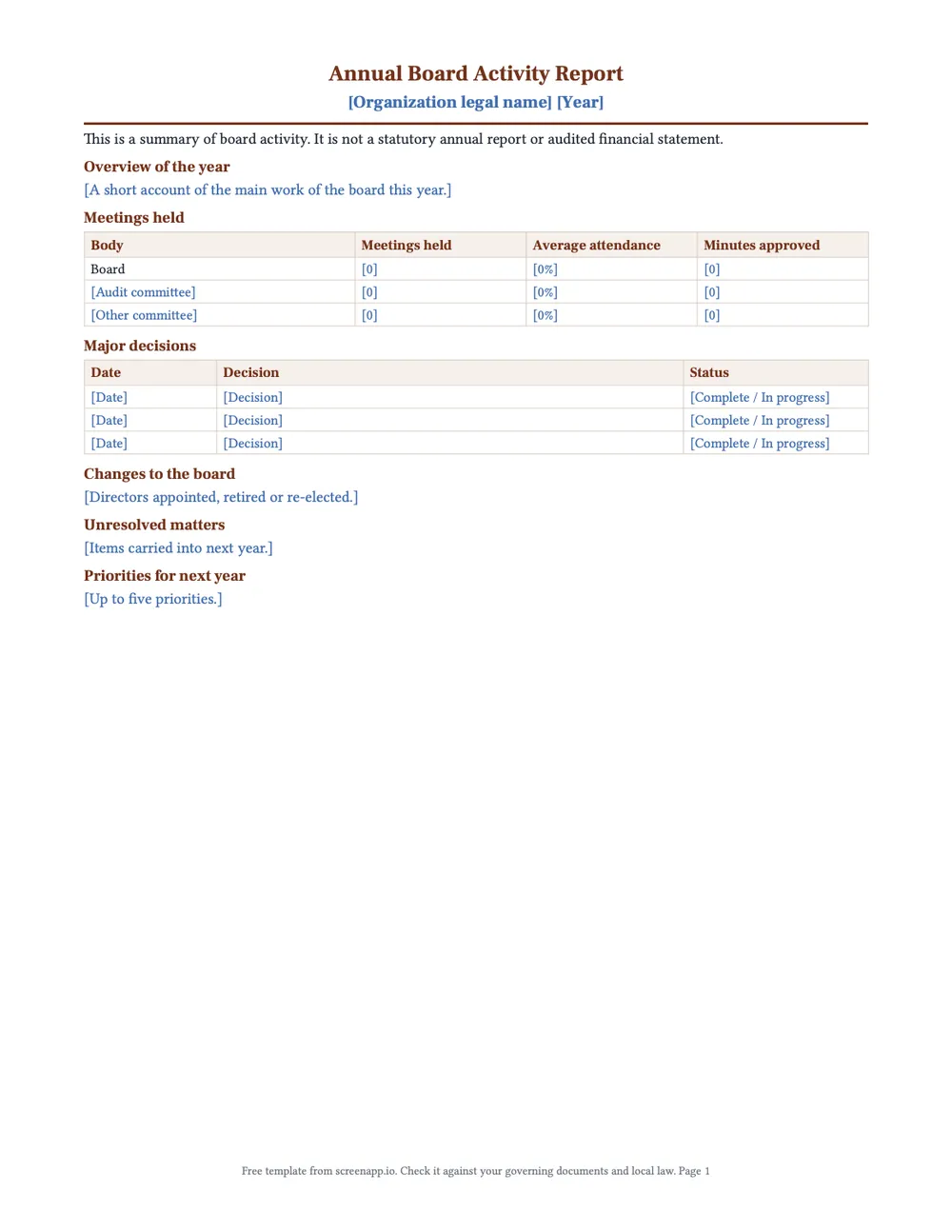
Annual Board Activity Report
Meetings held, major decisions and priorities. Not a statutory annual report.
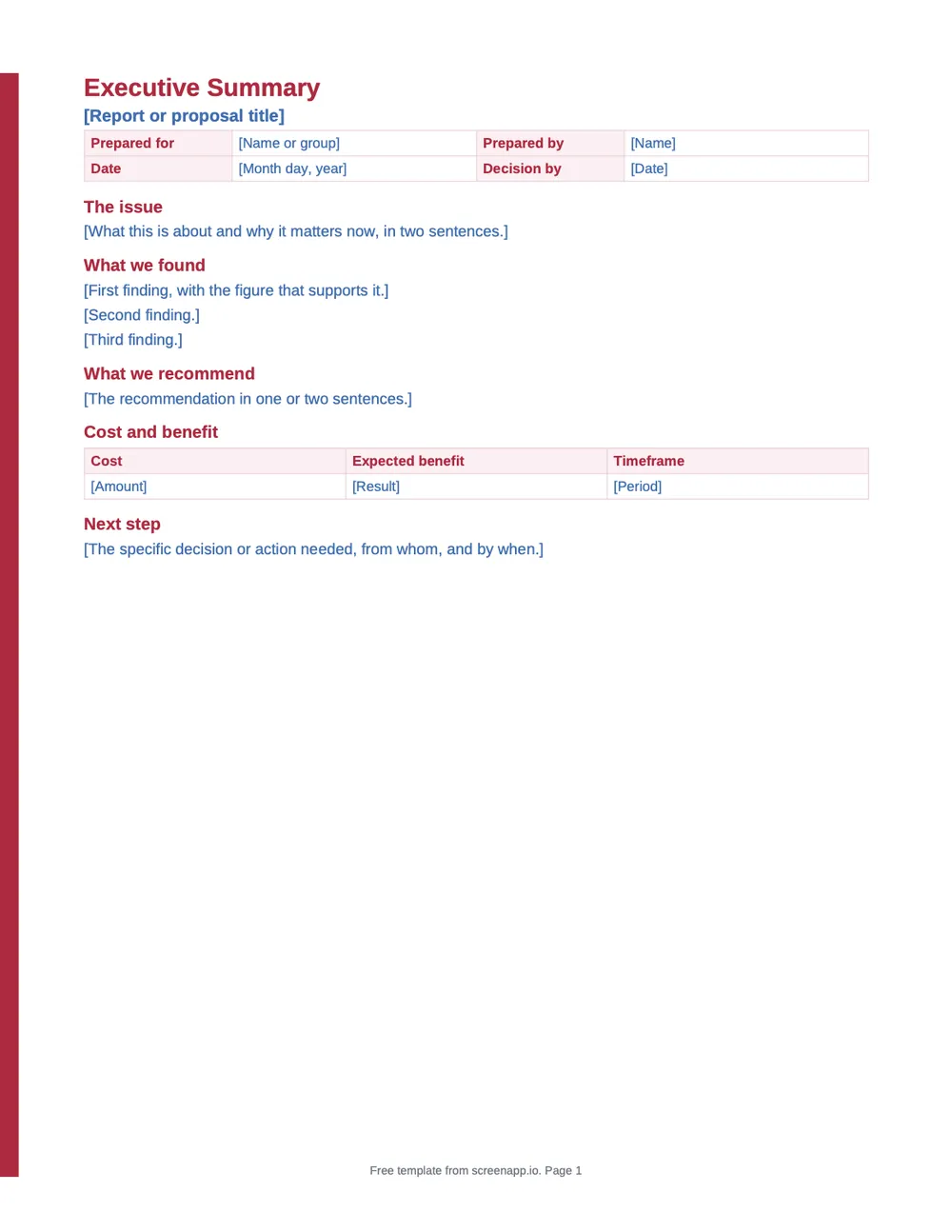
Executive Summary
The issue, findings, recommendation and next step on one page.
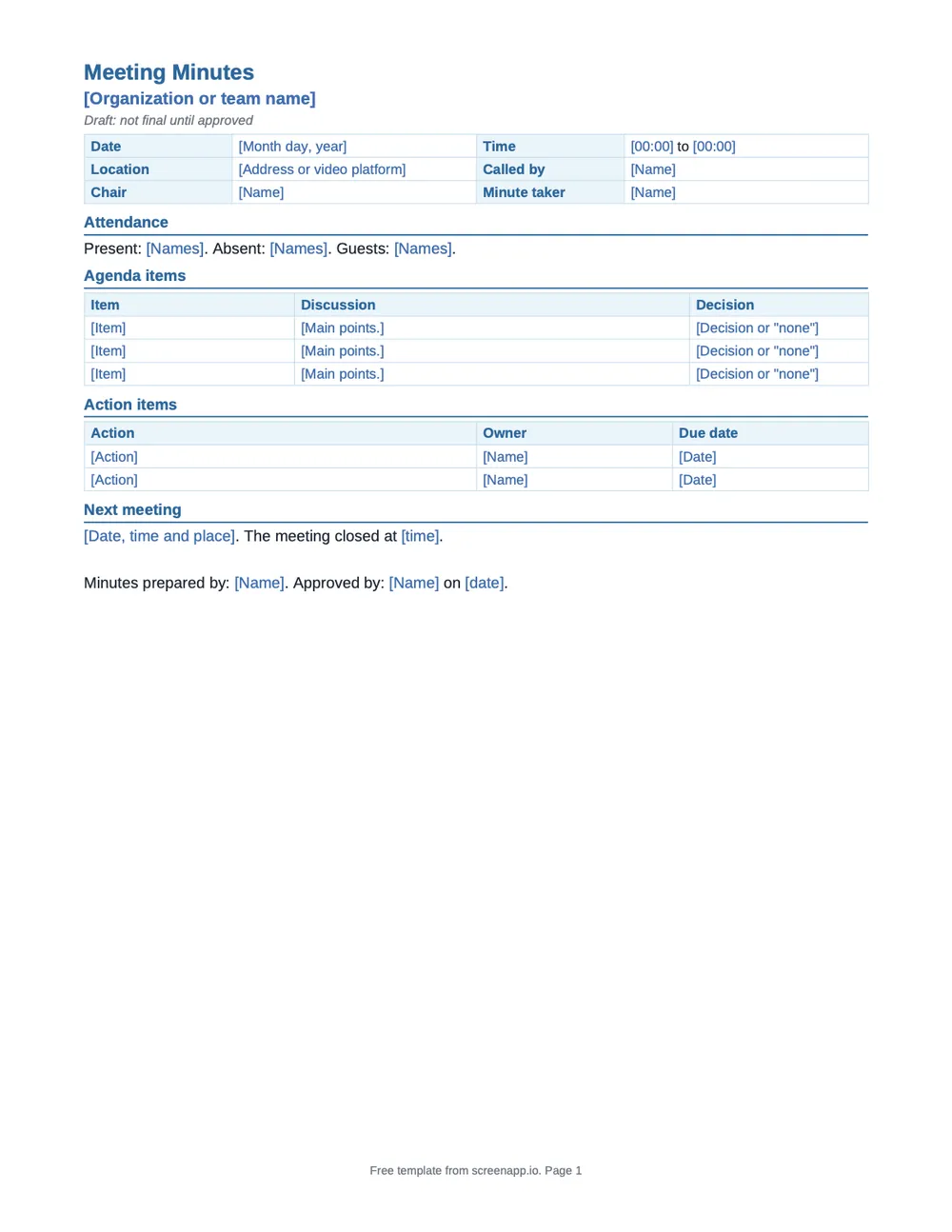
General Meeting Minutes
A plain form with agenda items, decisions and actions.
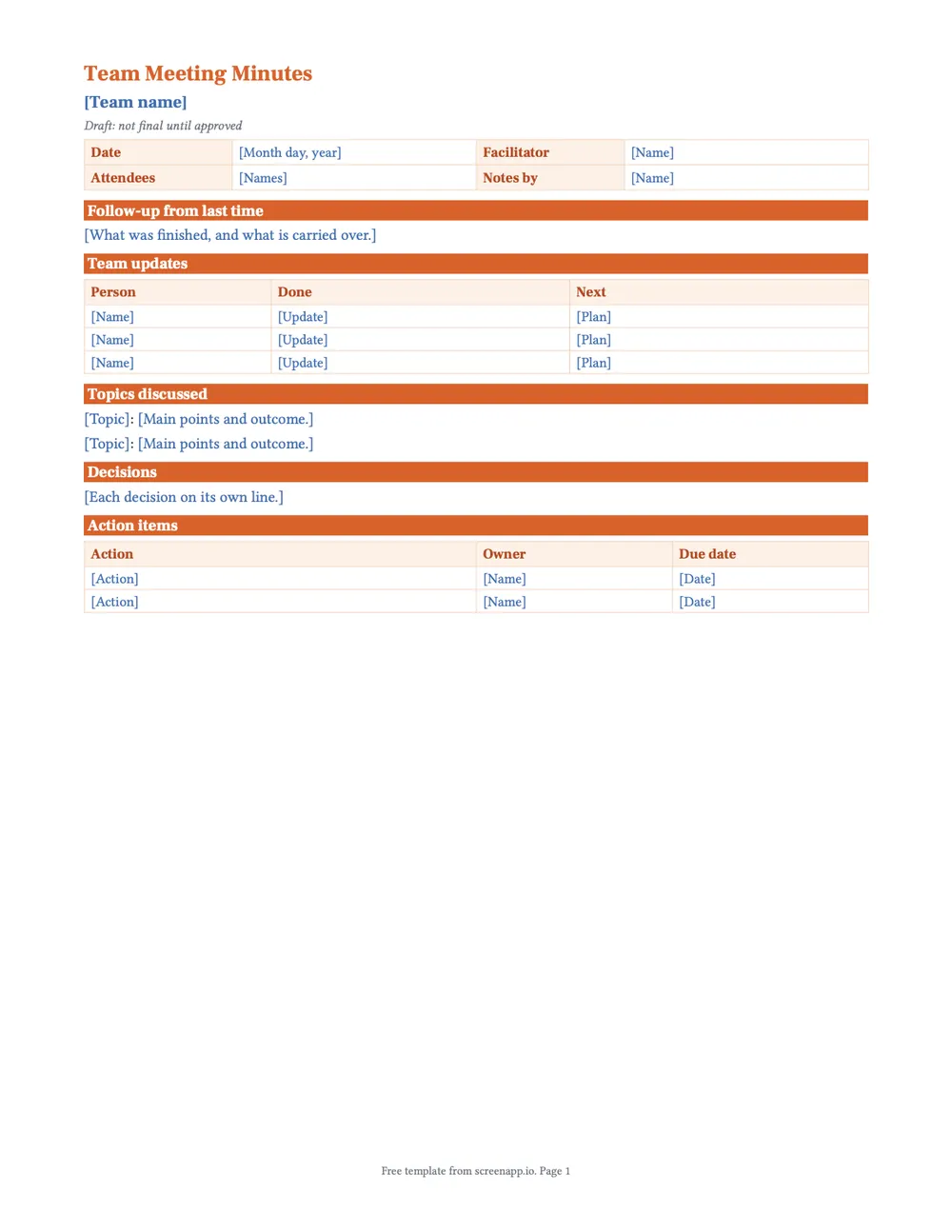
Team Meeting Minutes
Updates by person, topics discussed, decisions and actions.
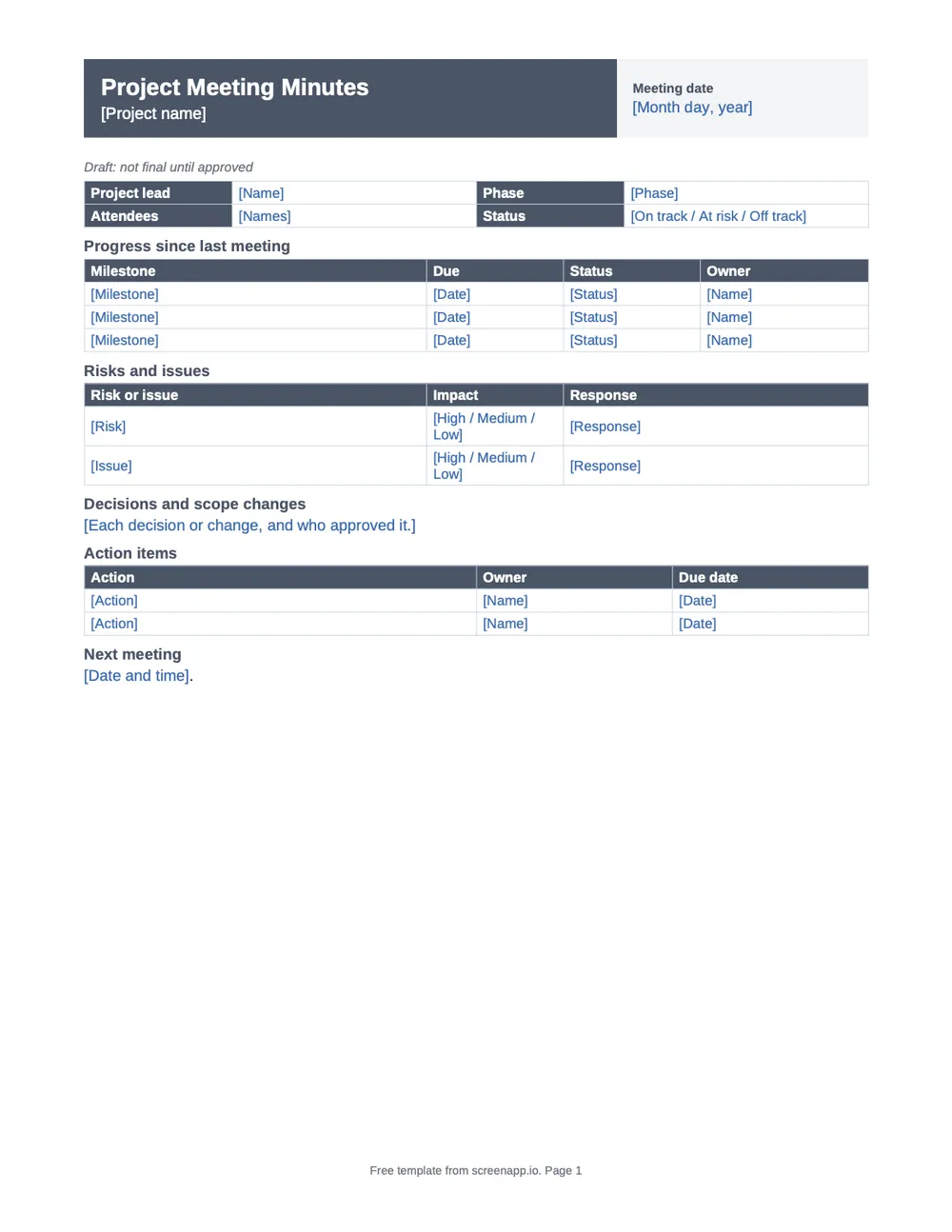
Project Meeting Minutes
Milestones, risks, scope changes and action items.
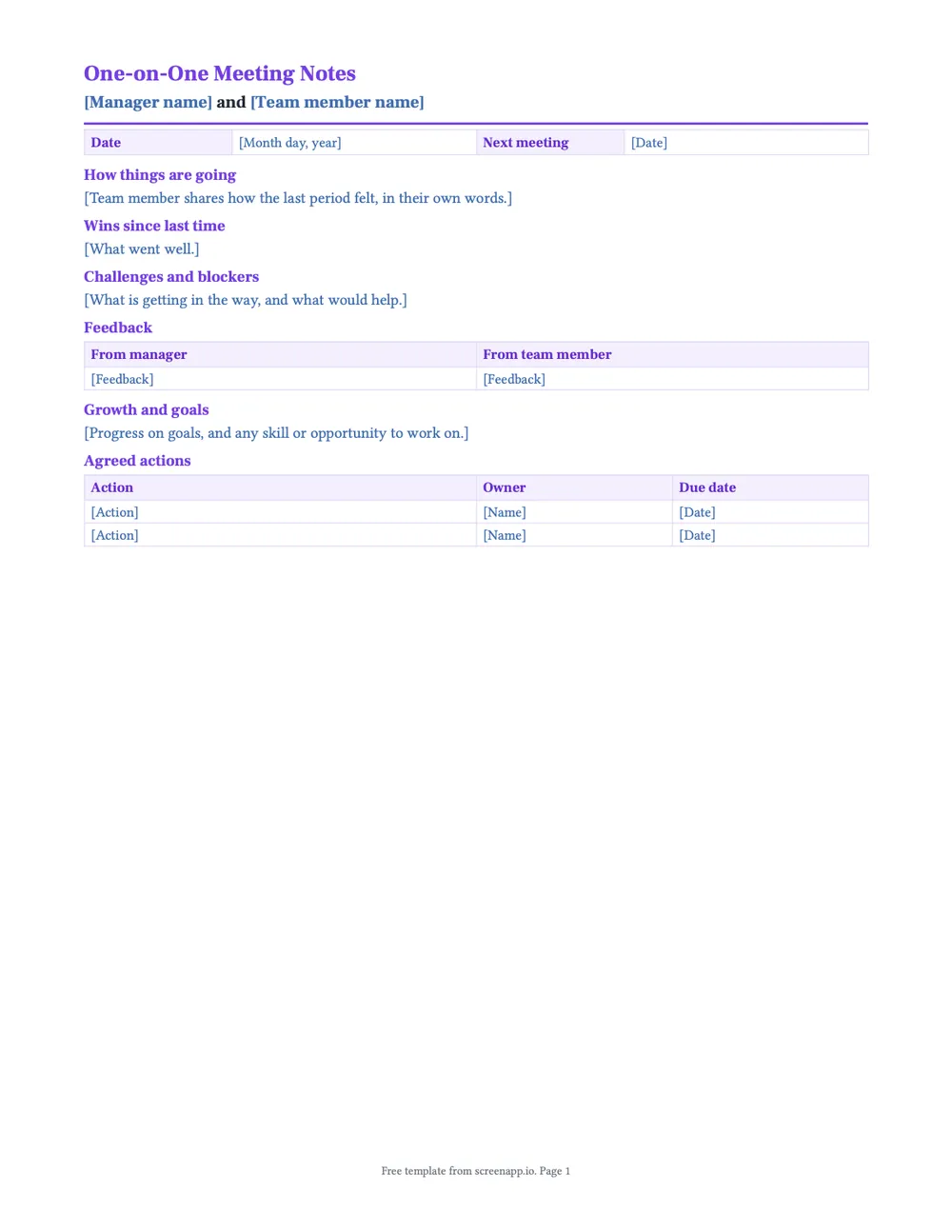
One-on-One Meeting Notes
Wins, blockers, two-way feedback and growth goals.
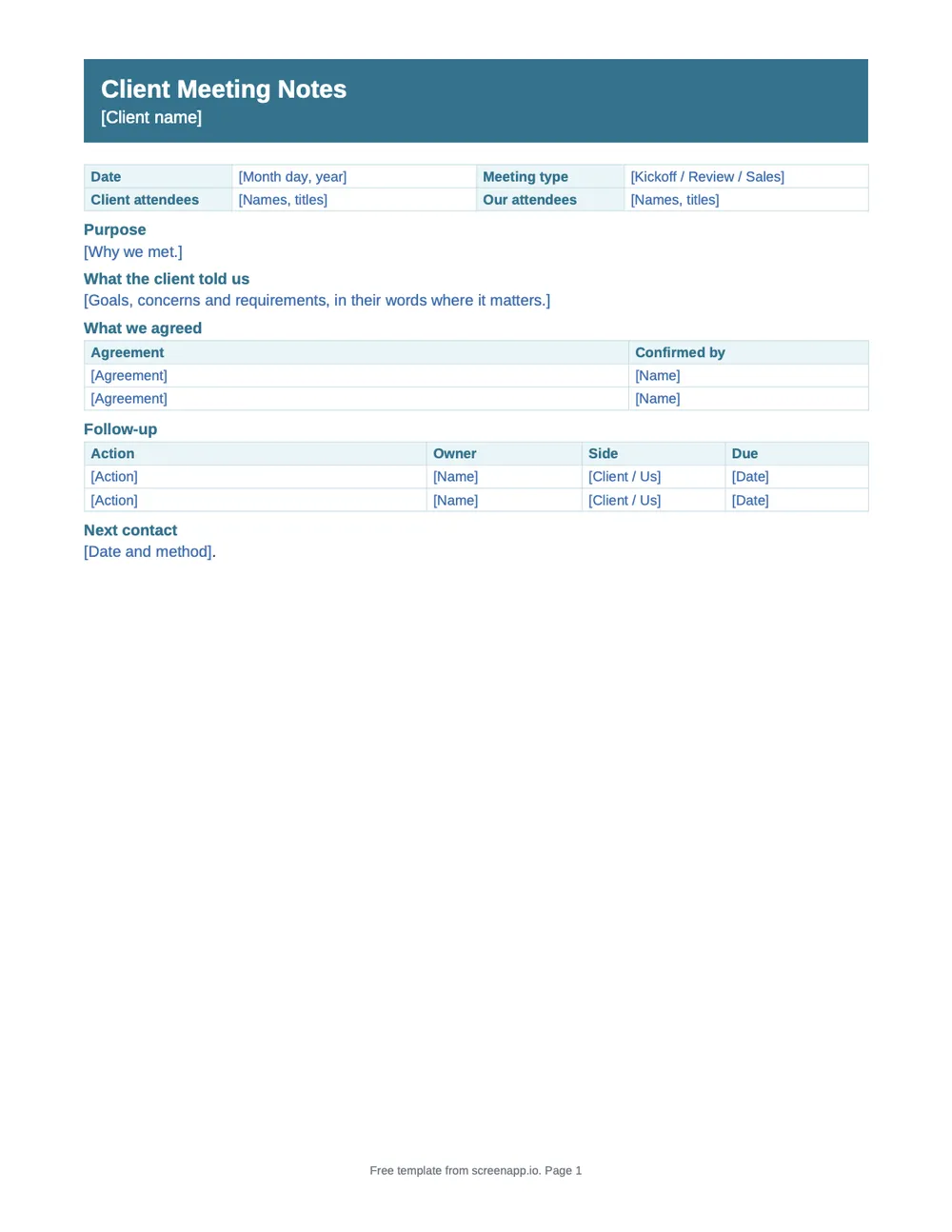
Client Meeting Notes
What the client said, what was agreed, and who follows up.
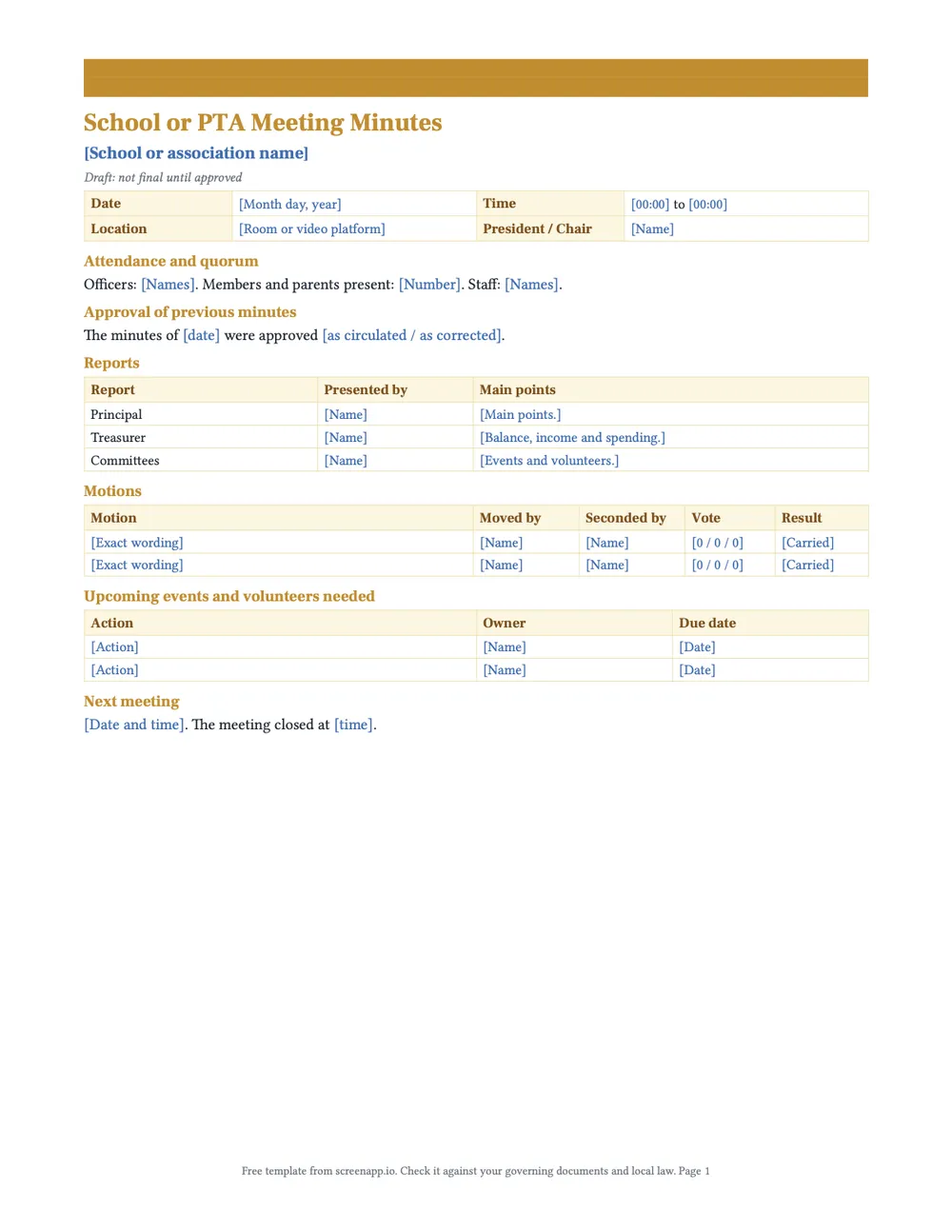
School or PTA Meeting Minutes
Principal and treasurer reports, motions and volunteers needed.
Copy a template as plain text
If you would rather paste a template into your own document, pick the closest version and delete any section you don’t use.
Minutes of a Meeting of the Board of Directors
[Company legal name]
Draft: not final until approved by the board

Date: [Month day, year]          Meeting type: [Regular / Special]
Start: [00:00] [time zone]       End: [00:00] [time zone]
Location: [Address or video platform]
Notice given: [Date, or "waived by all directors"]
Chair: [Name]                    Secretary of the meeting: [Name]

1. Attendance
Present in person: [Names]
Present remotely: [Names]
Absent: [Names, and whether apologies were received]
Also attending by invitation: [Name, title], for items [numbers] only

2. Call to order and quorum
The Chair called the meeting to order at [time]. [Number] of [number]
directors were present, which is a quorum under [section] of the
[bylaws / articles]. Notice of the meeting was [given on date / waived].

3. Declarations of interest
[No director declared an interest in any item on the agenda.]
OR [Name] declared an interest in item [number], left the meeting for
that item and did not vote.

4. Approval of previous minutes
The minutes of the meeting held on [date] were approved
[as circulated / as corrected] by the vote recorded in section 6.

5. Reports received
[Report name], presented by [Name]: [Received. One or two lines on the
main points and any concern raised.]

6. Motions and resolutions
Motion 1: Resolved, that [exact wording].
Moved by: [Name]   Seconded by: [Name]
For: [0]   Against: [0]   Abstain: [0]   Result: [Carried / Failed]
Recusals or recorded dissent: [Name, or "none"]

7. Other matters considered
[Item]: [The main points considered and the broad reason for the
outcome, in two or three sentences. No remarks attributed to
individual directors.]

8. Executive session
[The board met in executive session from (time) to (time). (Name) kept
the record. Decisions, if any, are recorded in section 6.]
OR [None held.]

9. Action register
[Action] | Owner: [Name] | Due: [Date]

10. Next meeting and adjournment
The next meeting will be held on [date] at [time]. There being no
further business, the Chair adjourned the meeting at [time].

Secretary of the meeting: ____________  Date signed: ________
Chair: ____________  Date approved by the board: ________
Minutes of a Meeting of the Board of [Trustees / Directors]
[Organization legal name]
Draft: not final until approved by the board
Date: [Month day, year] Time: [00:00] to [00:00]
Location: [Address or video platform]
Chair: [Name] Recording secretary: [Name]
1. Attendance and quorum
Present: [Names] Absent: [Names] Staff and guests: [Names]
[Number] of [number] board members were present, a quorum under
[section] of the bylaws.
2. Conflicts of interest
[None declared.] OR [Name] disclosed a conflict on item [number] under
the conflict of interest policy, left the room and did not vote.
3. Approval of previous minutes
The minutes of [date] were approved [as circulated / as corrected].
4. Reports received
Treasurer: [Received. Note restricted funds or grant conditions.]
Executive director: [Received. Main points.]
5. Motions and resolutions
Motion 1: Resolved, that [exact wording].
Moved by: [Name] Seconded by: [Name]
For: [0] Against: [0] Abstain: [0] Result: [Carried / Failed]
6. Action register
[Action] | Owner: [Name] | Due: [Date]
7. Adjournment
The meeting adjourned at [time]. Next meeting: [date].
Documented on: [date, for Form 990 timing if it applies]
Secretary: ____________ Date approved by the board: ________Minutes of a Meeting of the [Audit / Finance / Governance] Committee
of the Board of [Company legal name]
Draft: not final until approved by the committee
Date: [Month day, year] Time: [00:00] to [00:00]
Location: [Address or video platform]
Committee chair: [Name] Secretary: [Name]
1. Attendance and quorum
Members present: [Names] Absent: [Names] Invited: [Names, titles]
[Number] of [number] members were present, a quorum under the charter.
2. Declarations of interest
[None declared.] OR [Name] declared an interest in item [number].
3. Approval of previous minutes
The minutes of [date] were approved [as circulated / as corrected].
4. Matters considered
[Item]: [Main points and the broad reason for the outcome.]
5. Decisions and recommendations
Item: [Exact wording]
Outcome: [Decided by the committee / Recommended to the board]
Moved by: [Name] Seconded by: [Name] Vote: [For / Against / Abstain]
6. Report to the board
The chair will report items [numbers] at the board meeting on [date].
7. Action register
[Action] | Owner: [Name] | Due: [Date]
Committee chair: ____________ Date approved: ________Other kinds of board meeting need smaller changes:
| Meeting type | What to change |
|---|---|
| Advisory board | Use the committee version and record recommendations only. An advisory board normally has no power to bind the company. |
| Special meeting | State the purpose and the notice date in section 2. Check whether your bylaws limit the meeting to the noticed business. |
| Action without a meeting | Replace the minutes with the written consent signed by the required directors, and keep it with the minutes. |
| Annual general meeting | Record attendance and votes by members or shares, including proxies. |
Board Meeting Minutes Example
Everything in this sample is made up: the company, the people and the figures. It shows how short good minutes can be.
Completed minutes: Sample Manufacturing, Inc.
Minutes of a Regular Meeting of the Board of Directors
Sample Manufacturing, Inc.

Date: March 12, 2026             Time: 2:00 pm to 3:40 pm ET
Location: Head office boardroom, and by video
Notice given: March 2, 2026
Chair: J. Okafor                 Secretary of the meeting: L. Brandt

1. Attendance
Present in person: J. Okafor, M. Lindqvist, R. Alvarez
Present remotely: T. Nguyen, S. Patel
Absent: none
Also attending by invitation: D. Marsh, CFO, for items 5 and 6 only

2. Call to order and quorum
The Chair called the meeting to order at 2:00 pm. Five of five
directors were present, which is a quorum under Section 3.4 of the
bylaws. Notice of the meeting was given on March 2, 2026.

3. Declarations of interest
S. Patel declared an interest in motion 2 as a part owner of the
landlord, left the meeting for that item and did not vote.

4. Approval of previous minutes
The minutes of the meeting held on December 11, 2025 were approved
as circulated by the vote recorded in section 6.

5. Reports received
Q4 financial report, presented by D. Marsh: Received. The board asked
for the receivables aging to be added to future reports.

6. Motions and resolutions
Motion 1: Resolved, that the minutes of the meeting held on
December 11, 2025 are approved.
Moved by: M. Lindqvist   Seconded by: R. Alvarez
For: 5   Against: 0   Abstain: 0   Result: Carried

Motion 2: Resolved, that the Company may lease the warehouse at
200 Example Road for five years on the terms presented to this
meeting, and that the CEO may sign the lease.
Moved by: R. Alvarez   Seconded by: T. Nguyen
For: 4   Against: 0   Abstain: 0   Result: Carried
Recusals: S. Patel

7. Other matters considered
Cyber insurance renewal: The board considered two quotes and the
increase in premium. It wanted to compare retention levels before
choosing, so no decision was taken.

8. Executive session
None held.

9. Action register
Add receivables aging to the financial report | Owner: D. Marsh | Due: April 30
Bring retention comparison to next meeting | Owner: D. Marsh | Due: June 1

10. Next meeting and adjournment
The next meeting will be held on June 11, 2026 at 2:00 pm. There being
no further business, the Chair adjourned the meeting at 3:40 pm.
What to Include in Board Minutes
Every set of minutes needs the eight parts below. The order can change, but leaving one out is what causes trouble when someone checks the record later.
| Part of the minutes | What to write |
|---|---|
| Meeting details | Legal name of the company, meeting type, date, start and end time, place or video platform. |
| Attendance and quorum | Who was present, how they attended, who was absent, and the bylaw section that sets the quorum. |
| Conflicts of interest | Who declared one, on which item, and whether they left the room and abstained. |
| Previous minutes | The date of the minutes approved, and whether they were approved as circulated or as corrected. |
| Reports | That the report was received, with one or two lines on anything the board asked for. |
| Motions and votes | The exact wording, mover, seconder, vote count and result. |
| Action register | Each action, one named owner and a due date. |
| Signature block | Space for the secretary and chair to sign, and the date the board approved the minutes. |
This format is for formal governance meetings. Staff, project and client meetings need much less, and our guide to the different types of business meetings explains what each one is for.
How to Take Board Meeting Minutes
Most of the work happens before and after the meeting. In the room, your only job is to catch what can’t be rebuilt later: exact motion wording, votes, and when people come and go.

- Fill in the header, attendance list and any motions already drafted in the board pack.
- During the meeting, write motions word for word, with mover, seconder, votes and arrivals or departures.
- Write the draft within a couple of days, while you still remember why a decision went the way it did.
- Send it to the chair first, and to counsel if the meeting touched a dispute, an investigation or a conflict.
- Circulate it to directors, marked as a draft.
- Approve it at the next meeting and record any corrections.
- Sign it, file it in the minute book, and handle notes and drafts under your retention policy.
Approved minutes can take months to arrive if the board meets quarterly. If managers need their actions sooner, send a short meeting memo with the decisions and owners and keep the formal minutes moving on their own timeline. Under Robert’s Rules, corrections go into the text and the later minutes say only that the earlier ones were approved “as corrected.”
How Much Discussion to Record
Published guidance disagrees on this, so you have to pick a side.
Record only what was done
Robert's Rules is strict: "Minutes are a record of what was done at a meeting, not a record of what was said." Under this approach, section 7 of the corporate template mostly disappears.
Add main points and reasons
The Australian Institute of Company Directors agrees minutes are not a transcript, but its board minutes guidance says it is advisable to include "the key points of discussion and the broad reasons for decisions."
We built the template around the second view for company boards. If a decision is challenged two years from now, a line showing the board looked at two quotes and wanted a comparison is far more useful than a bare result. If your bylaws adopt Robert’s Rules, follow them and keep section 7 very short.
Board Minutes Best Practices
These are the places where board minutes most often go wrong, and what to do instead.
Write motions word for word
Record the final wording that was voted on, including amendments made in the room. Ask the mover to hand you the text or read it slowly, because a paraphrased resolution may not authorize what the board meant.
Record vote counts, and names only when needed
Counts are enough for most boards. Name individual directors when the board holds a roll call, when someone recuses, or when a director asks for their dissent to be recorded.
Show how a conflict of interest was handled
Say that the director declared the interest, left the room and did not vote, if all three happened. Then make sure the vote count adds up without that person, as it does in motion 2 of the example.
Recheck quorum when people leave
Quorum at the start doesn't settle it for the whole meeting. When directors leave, check your bylaws to see whether the meeting can still act, and note departures in the minutes.
Reference reports instead of summarizing them
Record that the report was received, and attach or reference it. A 30-page finance pack doesn't belong in the minutes.
Leave out who said what
Side conversations, jokes, remarks tied to one director and your own view of how the meeting went all stay out.
Legal Requirements by Country
The rules depend on where the company is registered and what kind of body it is. We checked these four against the source on 9 November 2026.
| Where | What the rule says | Source |
|---|---|---|
| Delaware corporations | One officer has the duty to record the proceedings of stockholder and director meetings in a book kept for that purpose. Written consents taken in place of a meeting are filed with the minutes. | DGCL 142(a) and 141(f) |
| UK companies | Minutes of all proceedings at directors' meetings must be recorded and kept for at least ten years from the date of the meeting. Failing to do so is an offence by every officer in default. | Companies Act 2006, s 248 |
| Australian companies | Proceedings and resolutions of directors' meetings go into a minute book within one month. Minutes must be signed within a reasonable time after the meeting. | Corporations Act 2001, s 251A |
| US nonprofits filing Form 990 | Form 990 asks whether every governing body and committee meeting was documented at the time. The IRS counts it as contemporaneous if done by the later of the next meeting or 60 days after the meeting. | Form 990 instructions, Part VI, line 8 |
Should You Record the Meeting?
Decide this as a board, in writing, before anyone presses record.
Its reasons are that important discussions can move offline and that a leaked recording can damage the company. It also points out that even when a recording exists, the minutes remain the formal legal record.
We sell recording software, so weigh that as you like, but those are fair concerns. If your board does allow recording, agree who can access the file, how long it is kept and when it is deleted. Ask counsel about consent rules and whether a retained recording could be requested in a legal dispute. Our notes on ethical meeting recording and AI transcription privacy at work cover the questions to settle first.
From Recording to Draft Minutes
There are two ways to use ScreenApp here, and the second doesn’t record the boardroom at all.
If your board has agreed to record
Upload the file to the meeting minutes generator. You get a transcript with speaker identification, and you can click a speaker label to rename it, match it to a team member, or reassign a single segment.
If your board doesn't record
Dictate a voice memo for AI meeting notes straight after the meeting while it's fresh: each item, what was decided, who owns what. Our guide to transcribing voice memos covers the iPhone steps.

If you already have the text, paste it into transcript to meeting minutes instead.
The Meeting Minutes output gives you action items with an owner and deadline, and decisions listed separately. You can export the draft as Markdown, TXT, PDF, DOCX and PPTX. ScreenApp is SOC 2 Type 2 audited and uses AES-256 encryption at rest, which your IT or legal team will likely ask about. No credit card required to try it.
FAQ
What should board meeting minutes include?
At minimum: the company name, date, time and place, who attended, confirmation of quorum, any conflicts declared, the exact wording of each motion with the mover, seconder and result, actions assigned, and signature lines. The template above has a section for each.
Who takes minutes at a board meeting?
Usually the corporate secretary or board secretary, or someone the chair appoints for that meeting. In Delaware the law says one of the officers has that duty, so if someone else takes the notes, an officer should still own the final record.
How do you document an executive session in minutes?
Record that the board went into executive session, the start and end times, who stayed in the room, and any decision made. Leave out the discussion itself. Keep this part short on purpose, the way section 8 of the corporate template is written.
Do board minutes need to be signed?
In Australia, section 251A requires signing within a reasonable time after the meeting. Elsewhere it often comes from the bylaws or from board practice. The safe default is for the secretary and chair to sign once the board has approved them.
How long should you keep board minutes?
UK companies must keep them for at least ten years. We'd keep them for the life of the company, because they are the record of what the board authorized. Check your own jurisdiction and your retention policy.
What is the difference between board notes and board minutes?
Notes are the secretary's working material from the room. Minutes are the approved document that becomes the record. Once minutes are approved, follow your retention policy for the notes and drafts, and ask counsel if you aren't sure.
Can AI write board meeting minutes?
AI can produce a first draft from a transcript or notes. It can't decide what belongs in the record, and it can smooth over the exact wording of a motion. Treat anything it writes as a draft for the secretary and chair to review against what happened.
What is the difference between board minutes and a transcript?
A transcript records every word. Minutes record the decisions, and for company boards the main points and broad reasons behind them. Minutes are the formal record, and a transcript should never be filed in their place.