12 Best One-Way Video Interview Platforms for Candidate Screening

On this page
A one-way video interview sends a candidate a set of prerecorded questions, they record their answers on their own schedule, and the hiring team reviews the responses whenever it suits them. No calendar back-and-forth, no time zone juggling, no interviewer sitting through the same opening question forty times in a week.
That scheduling gap is a real cost. SHRM research puts average time-to-fill for a role at over 40 days in many industries, and a meaningful chunk of that is spent coordinating first-round screening calls. Asynchronous video interviews remove that step entirely, letting a recruiter review 30 candidates’ answers to the same three questions back to back, in whatever order and at whatever pace they want.
This guide covers 12 platforms built specifically for one-way, asynchronous interviewing, not general video calling tools that happen to record. Every entry supports prerecorded questions, candidate video responses, and some form of structured review. Free tiers are noted where they exist, but the requirement to make this list is supporting one-way interviews well, not being free.
Related reading: If you specifically need a genuinely free option, see our guide to free video interview platforms. For the actual questions to ask once you have a platform, our best AI interview assistants guide covers structuring and scoring responses.
Quick Picks
Unlimited team collaboration on every plan, flat monthly pricing.
High-volume screening with a validated question library.
Structured async interviews with deep ATS integrations.
Transparent, published pricing with no sales call required.
Turns recorded responses into searchable, shareable notes for the panel.
One-Way Interview Platforms Compared
| Tool | Retakes | Question library | Collaborative review | Best for |
|---|---|---|---|---|
| Hireflix | Configurable per question | Custom question sets | Unlimited collaborators, no login required | Dedicated async screening |
| Willo | Configurable per question | AI question generator | Shared scoring and feedback | Fast setup, transparent pricing |
| Spark Hire | Typically 2-3 per question | Custom and template questions | Panel scoring and comments | Recruiter-led setup |
| HireVue | Often 3 per question | I-O psychologist-validated library | Structured panel scoring | High-volume enterprise hiring |
| VidCruiter | Often 2 per question | Custom question builder | Multi-rater scoring workflows | Compliance-heavy hiring |
| Jobma | Configurable per question | Custom question sets | Shared candidate review | ATS-integrated async screening |
| myInterview (Radancy) | Configurable per question | Template and custom questions | Team-based candidate review | Employer-branded screening |
| Vervoe | Configurable | Skills-based question library | Ranked candidate shortlists | Skills-based hiring |
| WedgeHR | Configurable per question | Custom question sets | Auto-generated response recaps | ATS-integrated screening |
| Odro | Configurable | Custom question sets | Shortlisting portal for stakeholders | Recruitment agencies |
| Talview | Configurable per question | Standardized question sets | NLP-assisted panel review | Bias-reduced, standardized screening |
| ScreenApp | Depends on source platform | Not applicable | Searchable transcript shared with panel | Reviewing responses across candidates |
Retake and time-limit defaults vary by plan and are usually configurable by an admin. The details above were checked in July 2026 - confirm current settings on each provider's help documentation.
The notes in each review below are our editorial read based on published product documentation, not a lab benchmark.
1. Hireflix - Best Overall for Async Screening
Hireflix is built around one thing: one-way video interviews, with nothing else bolted on. Recruiters set think time, answer time, and retakes per question, and candidates get a branded interview page with no account or app download required. Reviewers can leave timestamped comments on a response, and every hiring manager or executive can join the review at no extra cost.
Type: Web app | Price: Flat monthly rate, unlimited jobs and responses on paid plans, 1-month free trial
Pros: Unlimited team collaboration on every plan, automatic transcripts and closed captions, no-login-required sharing links, simple flat pricing
Cons: No live interview mode, so a separate tool is needed for later-stage panel interviews
2. Willo - Best for Fast Setup
Willo gets a job's interview questions live in minutes, with an AI question generator that drafts a starting set based on the role title. Candidates respond by video or audio, and hiring teams score and leave feedback inside the same dashboard.
Type: Web app | Price: Transparent published pricing, 15-day free trial
Pros: AI-assisted question generation, published pricing (no sales call required), supports audio-only responses for accessibility
Cons: Smaller ATS integration library than VidCruiter or Jobma, review scoring is less configurable than HireVue's
3. Spark Hire - Best for Recruiter-Led Setup
Spark Hire lets a recruiter build a one-way interview and launch it the same day, with control over prep time, response length, and retakes per role. It typically uses shorter answer windows than some competitors, often 60 to 90 seconds per question, which keeps reviews quick for high-volume roles.
Type: Web app | Price: Quote-based, no published self-serve pricing
Pros: Fast to launch a new role's interview, full branding on the candidate-facing page, panel scoring and shared comments
Cons: No published pricing, requires a sales conversation to get a quote
4. HireVue - Best for High-Volume Enterprise Hiring
HireVue pulls interview questions from a library built with industrial-organizational psychologists, which matters for large employers trying to keep screening consistent across thousands of candidates and multiple hiring managers. It commonly allows three retakes per question and locks structured, validated question sets so scoring stays comparable across a big applicant pool.
Type: Web app | Price: Enterprise contracts, quote-based, no self-serve free tier
Pros: Validated, structured question library built for consistency at scale, strong compliance and audit features, deep ATS integrations
Cons: Enterprise pricing and implementation timeline, overkill for a small hiring team screening a handful of roles a month
5. VidCruiter - Best for Compliance-Heavy Hiring
VidCruiter is built for hiring processes that need an audit trail, government agencies, healthcare systems, and other regulated employers where every step of a candidate's evaluation needs to be documented. It typically allows two retakes per question and supports multi-rater scoring so several reviewers can independently score the same response.
Type: Web app | Price: Contracts starting near $5,000/year, scaling with modules and compliance scope
Pros: Strong compliance and accessibility features, multi-rater independent scoring, works across live, async, and phone screening in one platform
Cons: Pricing scales quickly with added modules, more setup complexity than a dedicated one-way-only tool
6. Jobma - Best Value with ATS Integrations
Jobma supports asynchronous, live, and AI-assisted interviews in one account, and is used across healthcare, education, IT, and staffing agencies specifically for its ATS integration library. For a hiring team that already runs an applicant tracking system, that integration depth is the main reason to pick it over a newer, ATS-agnostic tool.
Type: Web app | Price: Tiered plans, published pricing available
Pros: Wide ATS integration support, combines async and live interviewing in one account, competitive pricing versus HireVue and VidCruiter
Cons: Interface has a steeper learning curve than Hireflix or Willo, smaller brand recognition among candidates
7. myInterview (Radancy) - Best for Employer Branding
myInterview was acquired by Radancy in 2025 and now sits inside a broader talent-acquisition suite, but its one-way interview product still focuses on employer branding: a fully customized candidate-facing page, personalized video intros, and team-based review of recorded responses.
Type: Web app | Price: Tiered plans, free plan available for limited volume
Pros: Strong employer branding controls, permanent free tier for low-volume screening, now backed by Radancy's broader recruiting platform
Cons: Post-acquisition roadmap and pricing are less predictable than an independent vendor, some features increasingly tied to the wider Radancy suite
8. Vervoe - Best for Skills-Based Screening
Vervoe pairs a one-way video response with a skills assessment, so a candidate might record an answer and then complete a task relevant to the role in the same session. Responses get ranked automatically against the assessment results, producing a shortlist rather than a raw pile of videos to watch.
Type: Web app | Price: Tiered plans, 7-day free trial with unlimited invites
Pros: Combines skills testing with video response in one flow, automatic ranked shortlists reduce manual review time, no card required for the trial
Cons: Best suited to skills-testable roles rather than general screening, shortest free trial window on this list
9. WedgeHR - Best for ATS-First Teams
WedgeHR is built to sit inside an existing ATS rather than replace the workflow around it, with integrations designed to reduce friction between screening and the rest of the hiring pipeline. It also auto-generates recaps of candidate responses, which speeds up review for teams screening a high volume of applicants.
Type: Web app, browser extension | Price: Tiered plans, quote-based
Pros: Deep ATS integration focus, automatic response recaps for faster review, built specifically for early-stage screening rather than full-cycle hiring
Cons: Less brand recognition than Hireflix or HireVue, pricing not published upfront
10. Odro - Best for Recruitment Agencies
Odro is built specifically for recruitment agencies rather than in-house talent teams, with a shortlisting portal that presents recorded candidate responses to client stakeholders alongside a CV. That agency-to-client handoff is the feature that separates it from tools built purely for internal hiring panels.
Type: Web app, browser extension | Price: Tiered plans, quote-based
Pros: Client-facing shortlisting portal built for agency workflows, supports both one-way and live interview modes, candidate engagement and feedback tools
Cons: Positioned mainly at recruitment agencies rather than direct employers, pricing requires a sales conversation
11. Talview - Best for Bias-Reduced Screening
Talview gives every candidate the same questions and the same response window by design, aiming to reduce inconsistency between interviewers. It layers speech-to-text transcription and NLP-based analysis on top of standard one-way responses, and operates in more than 120 countries for teams running global hiring programs.
Type: Web app | Price: Tiered enterprise plans, quote-based
Pros: Standardized question and time windows reduce interviewer bias, built-in speech-to-text transcription, strong global and multi-language support
Cons: Enterprise-oriented pricing and setup, NLP-based analysis features add a layer of complexity smaller teams may not need
12. ScreenApp - Best for Reviewing Responses Together
ScreenApp is not a dedicated interview-scheduling platform, it is a recording and transcription tool that pairs with whichever platform you use to collect responses. Once candidate videos are recorded, ScreenApp can transcribe them automatically, so a hiring panel can search across every candidate's answer to a specific question by keyword instead of scrubbing through video timelines one at a time.
Type: Web app | Price: Free plan with a monthly recording minute cap, paid plans unlock more minutes and team seats
Transparency note: We built ScreenApp. It solves a gap this list otherwise has: none of the dedicated interview platforms above make it easy to search transcribed answers across candidates the way ScreenApp does. Try the other tools too.
Pros: Automatic transcription of any recorded response, searchable across candidates and questions, works alongside any platform above rather than replacing it
Cons: Not built for scheduling, question libraries, or candidate invitations, works best as a companion tool rather than the primary interview platform
How a One-Way Interview Works
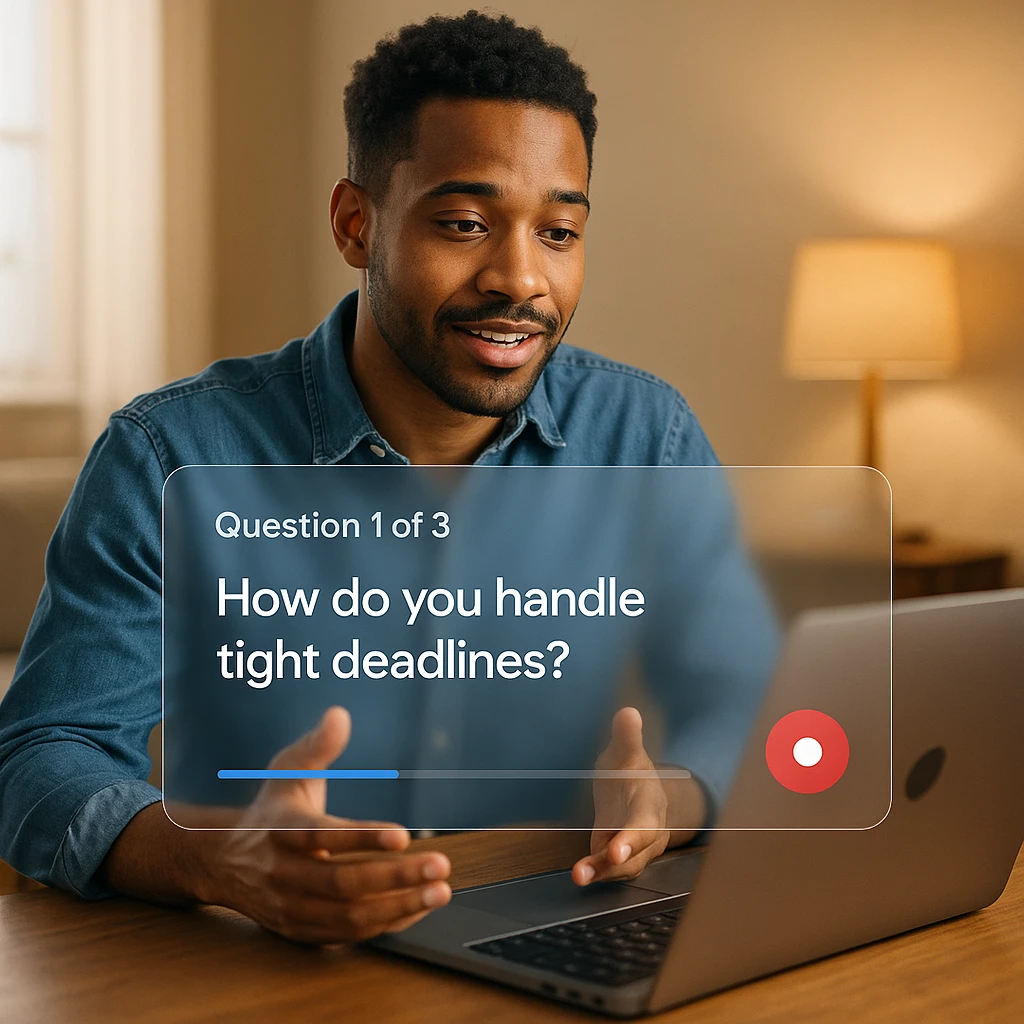
A one-way (asynchronous) video interview follows a fairly consistent flow across the platforms above, even though the interfaces differ.
A recruiter or hiring manager writes or selects a set of questions from a template library, then sets a think time (how long a candidate gets to prepare before recording starts), an answer time limit per question, and a retake allowance.
The candidate gets a link, usually with no account or app download required, and records answers whenever it suits them within a set window, often 3 to 7 days. Retakes let them redo an answer if the platform allows it, within the configured limit.
Reviewers watch responses on their own schedule, often with transcripts or closed captions to speed up review, and leave scores or timestamped comments. Multiple reviewers can score the same response independently before a group discussion, which reduces the influence of whoever interviews first.
One-Way vs Live Video Interviews
| One-way (asynchronous) | Live video interview | |
|---|---|---|
| Scheduling | None, candidate records anytime within a window | Requires matching calendars |
| Consistency | Every candidate gets the same question and time limit | Varies by interviewer and conversation flow |
| Best stage | Early-stage screening, high applicant volume | Later-stage, relationship-building conversations |
| Reviewer time | Reviewed on the panel’s own schedule | Requires interviewer availability in real time |
| Candidate experience | Some candidates find it impersonal | Feels more like a real conversation |
According to SHRM, employers increasingly use one-way interviews specifically to cut early-stage screening time, then move to a live interview once a shortlist is confirmed. The two formats are not competing approaches, most hiring processes above a handful of applicants use both: async for the first pass, live for the rounds that follow.
Choosing by Hiring Scenario
| If you need to | Use |
|---|---|
| Screen high volume with a validated, standardized question set | HireVue or Talview |
| Launch a new role’s interview the same day | Willo or Spark Hire |
| Keep pricing simple and predictable | Hireflix |
| Fit into an existing ATS workflow | Jobma or WedgeHR |
| Present shortlists to external clients | Odro |
| Combine a skills test with a video response | Vervoe |
| Meet compliance or audit requirements | VidCruiter |
| Search recorded answers across every candidate | ScreenApp alongside any tool above |

Reviewing Responses with ScreenApp
Watching every candidate’s recorded answer in full is the slowest part of asynchronous screening. ScreenApp can sit alongside your one-way interview platform and turn recorded responses into searchable, shareable notes. No software install needed.
Export or share the responses
Pull the recorded candidate responses from whichever interview platform you use.
Let ScreenApp transcribe them
Automatically, whether the source is screen, webcam, or audio-only.
Search across every candidate's answer
Find a specific question by keyword, then share a summary with the rest of the hiring panel.
After the Interview
- AI Note Taker: Turn recorded candidate responses into structured, shareable notes for the panel
- Transcription: Get a searchable text transcript of every recorded answer
- AI Video Summarizer: Condense a batch of candidate responses into a short summary before a shortlist meeting
Related reading: If your budget rules out a paid platform entirely, our free video interview platforms guide covers genuinely free and free-trial options. For structuring the actual questions you ask, see best AI interview assistants, and for recording longer conversations beyond hiring, our guide to recording captivating interviews covers technique.
FAQ
What is a one-way video interview?
A one-way video interview sends a candidate a set of prerecorded questions to answer on their own time, without a live interviewer present. The hiring team reviews the recorded responses afterward, on their own schedule.
How does an asynchronous interview work?
A recruiter sets up questions with a think time, answer time limit, and retake allowance. The candidate receives a link and records answers within a set window, often several days. Reviewers then watch, score, and comment on responses whenever it suits them.
What is the difference between one-way and live video interviews?
A one-way interview has no scheduling requirement and gives every candidate the same question and time limit, which makes early-stage screening faster and more consistent. A live interview happens in real time and works better for later-stage, relationship-building conversations.
Is there a free alternative to HireVue?
myInterview offers a free plan for limited volume, and Willo and Hireflix both offer no-card free trials with full feature access.
How many retakes should a one-way interview allow?
Most platforms default to two or three retakes per question. HireVue commonly allows three, VidCruiter often two, and tools like Hireflix and Willo let an admin set the number per question, so it can be adjusted per role.
How long should a one-way video interview be?
Most one-way interviews use 3 to 5 questions with a 60 to 120 second response window each, keeping the full interview under 10 minutes for the candidate and under 3 minutes of review time per response for the hiring team.
Can multiple people review the same candidate response?
Yes. Hireflix, VidCruiter, Talview, and most platforms on this list support collaborative review, where several reviewers score the same response independently before comparing notes, which reduces the influence of whoever reviews first.
What is Hireflix vs Willo vs Spark Hire best for?
Hireflix suits teams that want a dedicated one-way tool with simple flat pricing. Willo suits teams that want fast setup and published pricing without a sales call. Spark Hire suits recruiter-led teams that want to launch a new role's interview the same day.