

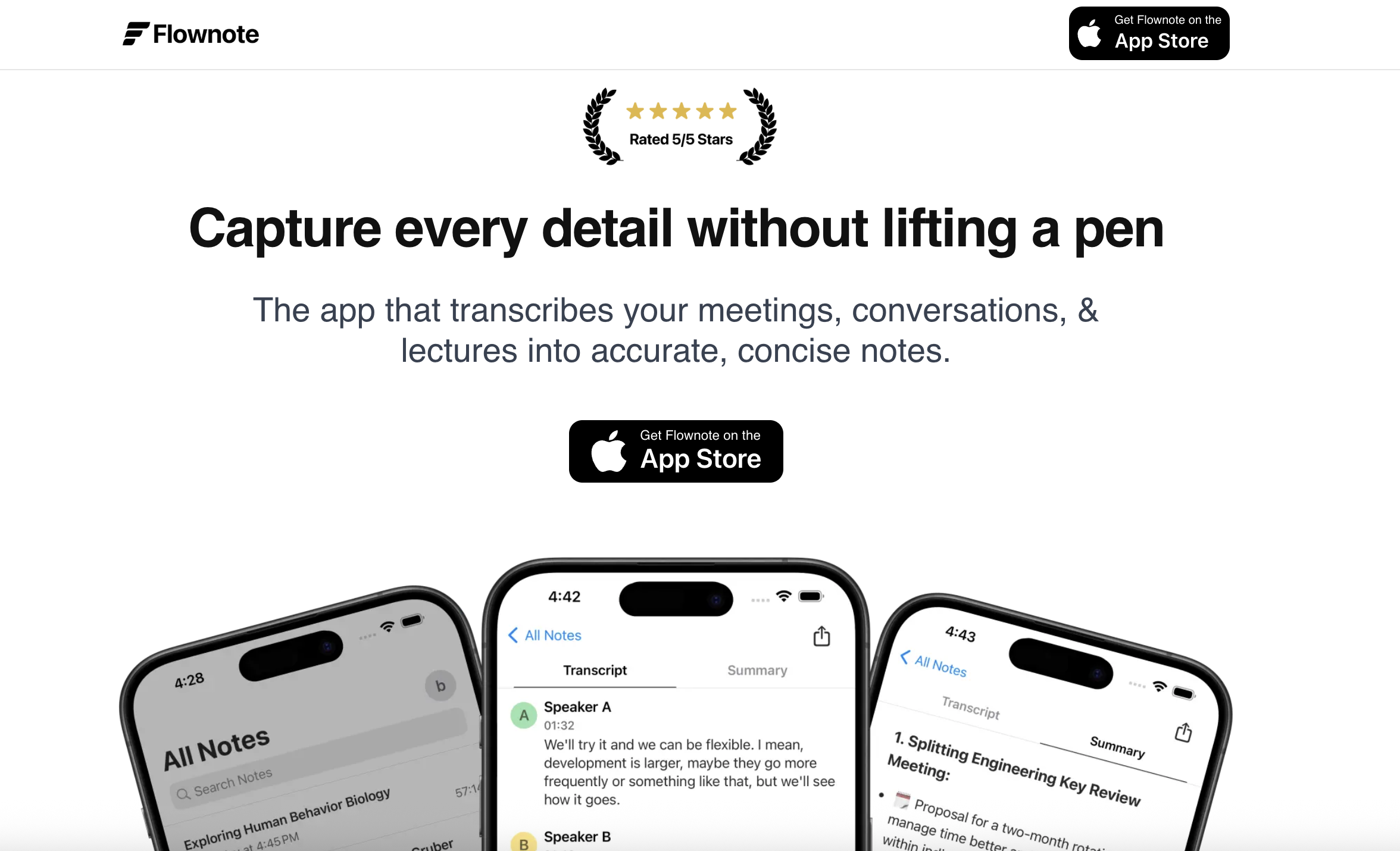
Flownote and ScreenApp both take meeting notes. For Flownote’s current feature list, limits and pricing, read flownote’s own site; those change often enough that restating them here would mislead you. What follows is what ScreenApp does, with a source for each figure.
What ScreenApp records
ScreenApp captures screen, window, browser tab, microphone and camera, with system audio. There is a meeting bot for Zoom, Google Meet and Microsoft Teams, with Google Calendar and Microsoft Calendar so it joins scheduled calls automatically. You can record without a bot from the Mac (Apple silicon) and Windows apps or the Chrome extension that records tab, screen, mic and camera, and there is live transcript while recording (beta).
The iOS and Android apps record voice and audio for in-person meetings, and ScreenApp records offline on iOS and Android, uploading when the connection returns. They do not record the phone screen.
What you get after a recording
- Speakers: speaker identification, and you can click a speaker label to rename it, match it to a team member, or reassign a single segment
- Action items: action items with an owner and deadline, and decisions listed separately
- Chapters: chapters with timestamps
- AI templates and documents, 21 built in
- AI chat with any recording, plus one AI chat that searches and answers from every recording in your library, or a single folder
- Search: search across recordings by name or transcript
- Playback sync: clicking a moment in the transcript jumps the player to that point in the recording
- Exports in PDF, DOCX, TXT, SRT and VTT
Transcription covers 100+ languages and the language is detected automatically per file. Speaker diarization works on 25 of them. ScreenApp’s accuracy page reports 95.8% on English studio audio, from ScreenApp’s April 2026 test, run before xAI Grok Speech-to-Text became the default transcription provider. Conference audio and field recordings score lower. This is ScreenApp’s own testing, not a third-party benchmark, and no head-to-head test against another tool has been run for this page. Note that overlapping speech can confuse the diarization system.
Security
ScreenApp holds SOC 2 Type 2 and encrypts data with AES-256. Recordings and content are not used to train AI models.
ScreenApp pricing
Free includes 2 transcriptions of recordings up to 45 minutes each and 3 uploads to try, plus 10 AI chats per month. No card is needed to sign up.
Pro is $19 a month billed annually ($228 a year) or $30 billed monthly, with recordings up to 2 hours, 50 transcriptions a month and 50 AI chats a month.
Max is $34 a month billed annually ($408 a year) or $69 billed monthly, with recordings up to 3 hours. AI chats on Max are Unlimited.
Enterprise is sales-led, from $199 a month. The 7-day trial is on annual Pro and Max plans and needs a credit card to start.
Teams and sharing
ScreenApp has team workspaces and share links. Share links are not password protected, so treat a share link as public to anyone who has it.
ScreenApp has a public API with API keys. It has no native Slack, Notion or Zapier integrations, so anything of that kind has to be built against the API.
FAQ
Does a bot have to join my call?
No. ScreenApp has a meeting bot for Zoom, Google Meet and Microsoft Teams if you want one, but the desktop app and browser extension record the call directly.
Can I record an in-person meeting?
Yes. The iOS and Android apps record voice and audio, and ScreenApp records offline on iOS and Android, uploading when the connection returns.
What can I export?
PDF, DOCX, TXT, SRT and VTT. Check presentation creation and download options in your signed-in account; transcript exports are separate from PowerPoint exports.