Best Audio Book Summary Apps: Listen to Key Ideas in Minutes

On this page
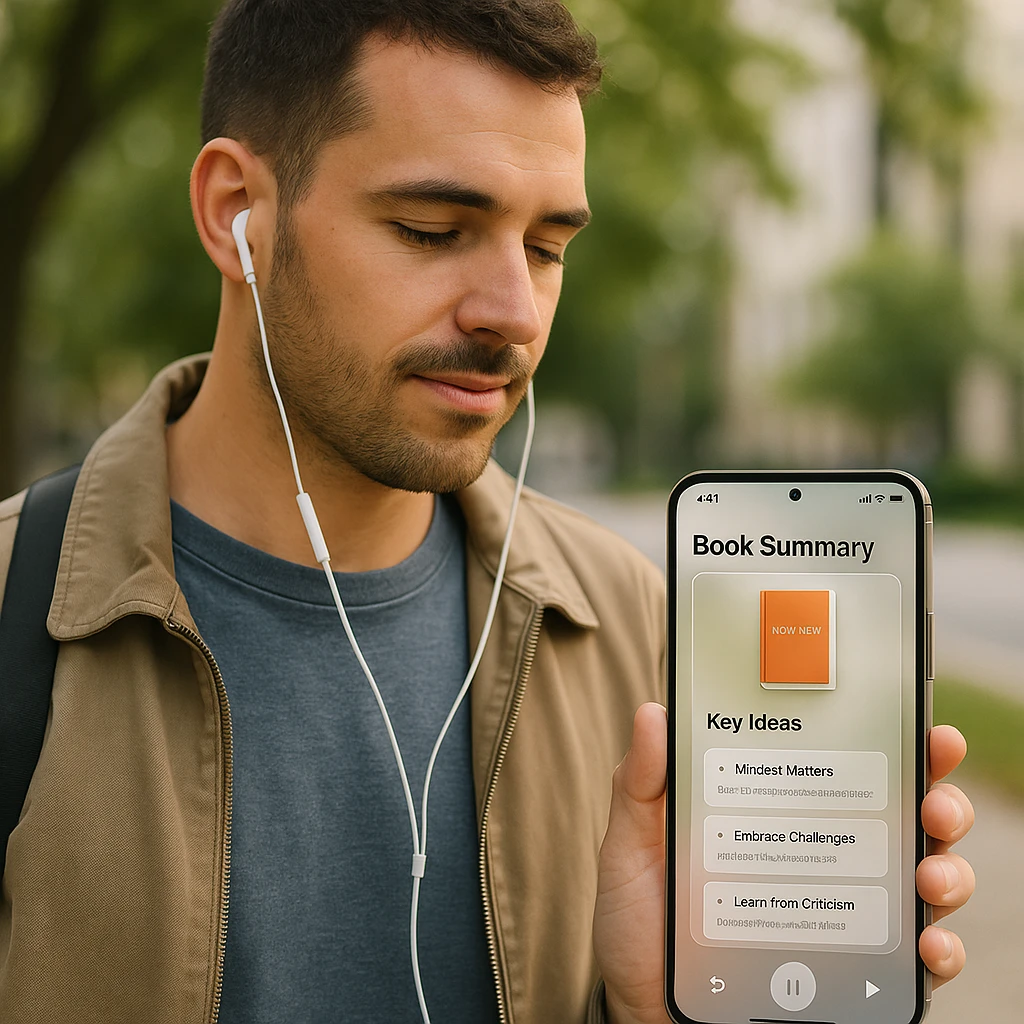
You want to read more books. You also have a commute, a job, and roughly zero free evenings. That gap is the whole reason audio book summary apps exist. They hand you the main ideas of a nonfiction book in 10 to 20 minutes instead of 10 hours.
I tried the popular ones the way a busy person actually uses them: on a phone, during a walk, half paying attention. This guide ranks the best audio book summary apps for 2026, and it splits them into two camps that most listicles blur together.
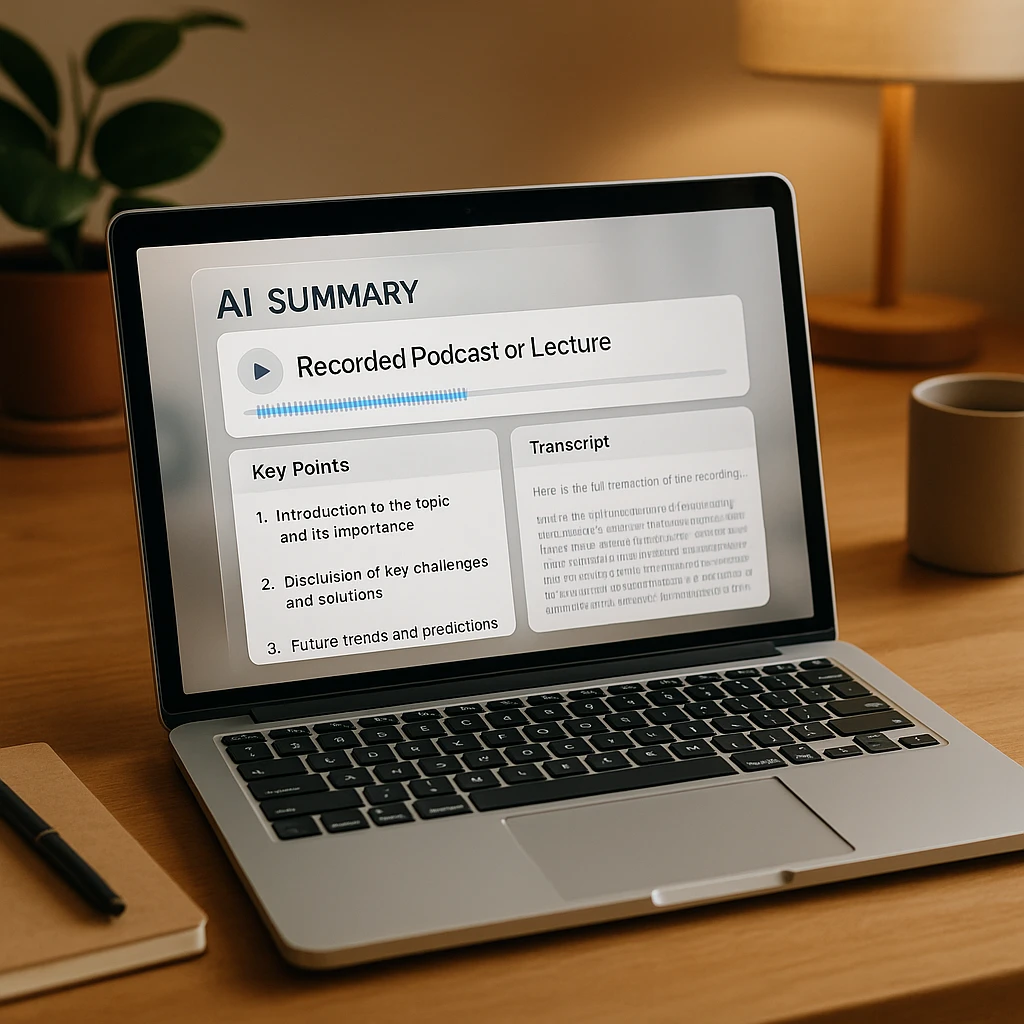
Camp one is the ready-made library. Blinkist, Headway, Shortform, StoryShots. You browse a catalog and press play. Camp two is the AI summarizer, like ScreenApp, which has no book catalog at all. It turns audio you already have, a podcast, a recorded lecture, a webinar, into notes and a summary. Different job, same goal of learning faster.
And the demand is not small. U.S. audiobook sales grew 9% in 2025 to $2.43 billion, according to Publishers Weekly, and audiobook listening has more than doubled in a decade. People want to learn by ear. The question is which app does it best for you.
For related guides, see our roundup of AI tools that listen and take notes and our walkthrough on turning long recordings into clean summaries.
Quick picks
The biggest nonfiction library, with 15-minute summaries you can read or listen to.
A free daily summary in text and audio, and the cheapest premium plan of the bunch.
Long-form guides with analysis and exercises, for people who want more than a teaser.
Not a book library. Summarizes podcasts, lectures, and recordings you already have.
What an Audio Book Summary App Actually Does
An audio book summary app gives you a short audio version of a book, usually 5 to 30 minutes, covering the main ideas, the lessons worth keeping, and the practical takeaways. It is not narration of the book. Someone (or increasingly, something) has read the book for you and recorded the condensed version.
That makes it a different product from an audiobook app, and mixing the two up is how people end up paying for the wrong subscription. The quick way to tell them apart:
| Feature | Audio book summary app | Audiobook app |
|---|---|---|
| Length | 5 to 30 minutes | Several hours |
| Purpose | Understand the key ideas quickly | Listen to the full book |
| Best for | Learning fast, screening books | The full reading experience |
| Examples | Blinkist, Headway, Shortform, StoryShots | Audible, Apple Books, Spotify Audiobooks |
If you want hours of narration, get Audible and skip this list. If you want the ideas from ten books in the time one audiobook takes, keep reading.
Book Summary Apps Compared
| App | Best for | Audio | Free option | Price |
|---|---|---|---|---|
| ScreenApp | Your own audio and video | Yes, of your uploads | Free tier | Free, paid Pro |
| Blinkist | Biggest nonfiction library | Yes | 1 free summary a day | About $15/mo or $100/yr |
| Headway | Personal growth and habits | Yes | 1 free summary a day | About $13/mo or $90/yr |
| Shortform | In-depth book guides | Some titles | Short free trial | Premium, around $180/yr |
| StoryShots | Free book summaries | Yes | Yes, free daily | Free, premium about $30/yr |
| Instaread | Business and nonfiction | Yes | Limited | Subscription |
| getAbstract | Corporate and professional | Yes | Limited, business-focused | Subscription |
Pricing checked in July 2026 and rounded. Plans and free tiers change often, so confirm on each app's site before you pay.
Here is each app in more detail, starting with the AI outlier and then the ready-made libraries.
The out-of-ten scores below are our editorial read, not a lab benchmark.
1. ScreenApp
Best for AI summaries of your own audio and video
We built ScreenApp, so read this ranking with that bias in mind. It is the odd one out here because it does not sell book summaries at all. It summarizes audio and video you bring: a podcast episode, a recorded lecture, a webinar, a long voice note. Upload the file and you get a transcript, the key points, and a short summary you can search later. If the "book" you want condensed is a three-hour course recording or a founder interview, this is the tool. If you want a pre-written take on Atomic Habits, it is not, and the libraries below will serve you better.
Key Features
Pros
- -Summarizes any audio or video you own, not a fixed catalog
- -Hands back a searchable transcript plus notes, not audio only
- -Useful for lectures, podcasts, and meetings, not only books
Cons
- -No ready-made book catalog like Blinkist
- -Summary quality depends on the audio, and you need a file to begin
Best For
Students summarizing lectures, professionals condensing webinars and calls, and anyone whose "reading list" is really a pile of recordings.
  <div class="flex-1 flex flex-col" style="padding-top: 0.5em; padding-bottom: 0.5em;">
    <h2 class="text-2xl font-semibold text-gray-900 mb-1 mt-2" style="padding-top: 0;">2. Blinkist</h2>
    <p class="text-gray-600 text-base !mb-0" style="padding-bottom: 0.5em;">Best overall book summary library</p>
  </div>
</div>
Blinkist is the app most people picture when they hear "book summary app." Its nonfiction library is the biggest here, and each summary (a "Blink") runs about 15 minutes in text or audio. The narration is clean and the recommendations are solid. One catch for 2026: Blinkist dropped its free trial in February, so the free tier is now a single pre-selected summary per day. Full access runs about $15 a month, or roughly $100 a year, with a pricier Pro tier that adds AI features.
Key Features
Pros
- -The largest nonfiction library on this list
- -Clean 15-minute audio with good narration
- -Offline listening and solid recommendations
Cons
- -The free trial is gone; one pre-selected daily summary now
- -Summaries can feel thin for deep readers
- -Full access needs a subscription, about $100 a year
Best For
Busy professionals and nonfiction readers who want the most polished ready-made summary library and will pay for it.
3. Headway
Best for self-improvement and habits
Headway leans hard into personal growth: habits, productivity, mindset. It wraps summaries in visual cards, daily streaks, and spaced repetition so you actually remember what you heard, which is a genuinely nice touch most rivals skip. Like Blinkist, it hands out one free summary a day, then charges about $13 a month or roughly $90 a year.
Key Features
Pros
- -Strong self-help catalog with spaced repetition for retention
- -Engaging mobile design that makes daily learning easy
- -One free summary a day, cheaper than Blinkist at about $90 a year
Cons
- -Thin outside self-improvement topics
- -Best experienced on mobile; the web version is secondary
- -The full plan needs a subscription
Best For
Self-help readers who want a daily habit, visual learners, and anyone who forgets what they listened to last week.
  <div class="flex-1 flex flex-col" style="padding-top: 0.5em; padding-bottom: 0.5em;">
    <h2 class="text-2xl font-semibold text-gray-900 mb-1 mt-2" style="padding-top: 0;">4. Shortform</h2>
    <p class="text-gray-600 text-base !mb-0" style="padding-bottom: 0.5em;">Best for in-depth book guides</p>
  </div>
</div>
Shortform goes the opposite direction from the 15-minute crowd. Instead of a teaser, it writes long guides with chapter-by-chapter breakdowns, analysis, and exercises. For a dense book you actually want to understand, it is the best here. The tradeoff is time and money: guides run well past five minutes, audio is not the main event, and it is premium-only after a short trial, around $180 a year.
Key Features
Pros
- -The most detailed summaries on this list
- -Good for serious study and book clubs
- -Strong written guides with exercises
Cons
- -Not a quick 5-minute listen
- -Audio is secondary to the text
- -The priciest option here at around $180 a year
Best For
Deep learners, book clubs, and professionals who want analysis and exercises rather than a quick takeaway.
5. StoryShots
Best free book summary app
StoryShots is the answer to "is there a free app like Blinkist." It gives a free summary a day in a few formats: text, audio, and animated versions for some titles. The premium plan is the cheapest of the group, around $30 a year with a lifetime option, so even paying feels light. The experience is less polished than Blinkist and the library is smaller, but for free summaries it is hard to beat.
Key Features
Pros
- -A genuinely useful free tier
- -Multiple formats for the same title
- -The cheapest premium plan on this list
Cons
- -Less polished than the paid rivals
- -A smaller library, and depth varies by title
Best For
Budget-conscious readers, students, and anyone trying a book summary app for the first time without paying.
  <div class="flex-1 flex flex-col" style="padding-top: 0.5em; padding-bottom: 0.5em;">
    <h2 class="text-2xl font-semibold text-gray-900 mb-1 mt-2" style="padding-top: 0;">6. Instaread</h2>
    <p class="text-gray-600 text-base !mb-0" style="padding-bottom: 0.5em;">Best for quick business summaries</p>
  </div>
</div>
Instaread keeps it simple: short insights from nonfiction, business, politics, and productivity books, in text and audio. No streaks, no visual cards, just the summary. If you want business takeaways without a learning-app wrapper, that plainness is the appeal. Brand awareness is smaller than Blinkist, and the extra learning features are thin.
Key Features
Pros
- -Simple and quick, easy to understand
- -Good business and nonfiction focus
- -No clutter or forced gamification
Cons
- -Smaller brand and library than Blinkist
- -Few interactive learning features
Best For
Business readers and professionals who want plain summaries without streaks, cards, or a learning-app wrapper.
7. getAbstract
Best for corporate and professional learning
getAbstract is built more for teams than solo readers. It focuses on business, leadership, and professional development, and companies often buy it for training. The summaries are expert-curated and it fits neatly into corporate learning programs. For casual reading it can feel formal, and it leans toward organizations rather than individuals.
Key Features
Pros
- -A strong business and leadership catalog
- -Expert curation with professional-quality summaries
- -A good fit for teams and corporate training
Cons
- -Feels formal for casual reading
- -Geared toward organizations more than individuals
Best For
Managers, teams, and companies that want book summaries inside a corporate training program.
Best Free Audio Book Summary Apps
Free means limited in this category, and the limits changed in 2026. Blinkist and Headway both killed their free trials and now hand out one pre-selected summary a day. So set your expectations: a free plan gets you a taste, ads or a locked library, and rarely offline listening. Here is what free actually buys you right now.
| App | Free option | Best free use |
|---|---|---|
| StoryShots | Yes, a free summary a day | Free book summaries in text and audio |
| Blinkist | 1 pre-selected daily summary | Sampling premium-quality summaries |
| Headway | 1 free daily summary | Self-growth summaries with retention cards |
| ScreenApp | Free tier | Summarizing your own audio or video files |
If free is the whole point, start with StoryShots for books and ScreenApp for your own recordings. Between the two you can cover a surprising amount of learning without a subscription.
For Students: Summaries Beyond the Reading List
Students are the group these apps quietly undersell. A book summary app covers the assigned nonfiction, but most of what a student needs condensed was never published as a book: lectures, seminar recordings, study group calls, that 90-minute review session before finals.
So the honest recommendation is a split. Use StoryShots (free) or Blinkist for the books on the syllabus, and Shortform if a single dense book is the whole course. For everything recorded, run it through an AI summarizer instead: upload the lecture, get the transcript and key points, and revise from those. We covered that workflow in our guides to the best free AI lecture note takers and recording lectures and converting them to text.
For Professionals: Commutes, Webinars, and Book Clubs You Skipped
The professional case is the classic one: a commute, a leadership book you were told to read, no time. Blinkist handles that in 15 minutes a day, and getAbstract is the pick when the company is paying and the whole team needs the same training library.
The overlooked half is the same as with students. A professional’s backlog is mostly not books: recorded all-hands, webinars, sales calls, conference talks. A book app cannot touch those. An AI summarizer can, and pairing one with a summary library covers both halves of the pile. Shortform earns its price here only if you actually apply books, its exercises are built for that.
A Free App Like Blinkist
“Best app like Blinkist but free” is one of the most-searched questions in this niche, and the honest answer has a catch. Nothing free matches Blinkist’s library size and polish. But depending on why you wanted Blinkist, one of these gets close enough:
| Alternative | Why pick it |
|---|---|
| StoryShots | The strongest free book summary option, and premium is only about $30 a year |
| Headway | A free daily summary with better retention tools, if self-growth is your shelf |
| Instaread | Simple nonfiction summaries without the learning-app wrapper |
| ScreenApp | Free AI summaries of audio and video you already have, no book catalog needed |
| Shortform | Not free, but the pick if Blinkist felt too shallow rather than too expensive |
A free alternative makes sense if you only want the occasional summary. If you listen daily, the paid apps earn their fee with bigger libraries, offline listening, and a smoother app. Do the math on how many summaries you actually finish a month before paying for any of them.
How to Pick the Right One
Five things separate a good pick from a wasted subscription. Run through them before you pay.
Format
Audio, text, visual cards, or full guides. If you learn by ear on a commute, an audio-first app like Blinkist or StoryShots fits. If you want to read and annotate, Shortform.
Library depth
Check the categories you actually read: business, psychology, finance, health, leadership. A huge library is useless if it is thin on your shelf.
Free vs paid
If you only want the occasional summary, StoryShots or a daily free Blinkist summary is plenty. Heavy readers get more from a yearly plan than a monthly one.
Audio quality
For an audio-first app, narration, playback speed, offline listening, and background play matter more than the app store rating. Blinkist and Headway lead here.
AI summary features
If the thing you want summarized is not a book but a lecture, podcast, or webinar you recorded, a fixed library will not help. That is where an AI summarizer earns its place. Students especially lean on this for recording lectures and turning them into text rather than paying for a book app they barely touch.
The Verdict
There is no single best audio book summary app, only the best one for how you learn.
| If you want | Best pick |
|---|---|
| A big library and polished audio | Blinkist |
| Free book summaries | StoryShots |
| Deep, detailed guides | Shortform |
| Personal growth and habits | Headway |
| Business and corporate learning | getAbstract |
| To summarize your own audio or video | ScreenApp |
For most people learning from nonfiction, Blinkist is the safe pick and StoryShots is the free one worth trying first. But if your “reading list” is really a pile of recorded talks, podcasts, and lectures, no book app covers it. That is the gap ScreenApp fills, and it is why it sits on a list it does not obviously belong on.
Want more on pulling ideas out of audio and video faster? See our guides to the best AI transcription tools and the best PDF to speech converters for reading by ear.
よくある質問
What is the best app to listen to book summaries?
Blinkist is the most popular choice, with the biggest nonfiction library and clean 15-minute audio. If you want free summaries, StoryShots is the better place to start. And if you want to listen to summaries of your own recordings instead of pre-made books, an AI summarizer like ScreenApp does that.
What is the best free book summary app?
StoryShots is the strongest free book summary app. It gives you a free summary a day in text and audio, and its premium plan is the cheapest here at about $30 a year. Blinkist and Headway also offer one free summary per day, though their free trials are gone as of 2026.
Is Blinkist better than Audible?
They do different jobs. Blinkist gives 15-minute summaries of a book’s main ideas. Audible sells full audiobooks that run for hours. Blinkist is better for learning fast and deciding what to read next. Audible is better when you want the whole book, story and all.
What app summarizes books into audio?
Blinkist, Headway, StoryShots, and Instaread all turn book summaries into audio you can play. For summarizing audio you already have, a podcast or a lecture rather than a book, an AI tool like ScreenApp does it, as long as you have the right to use the recording.
Are book summary apps worth it?
Yes, if you want to learn faster, review key ideas, or decide which books deserve the full read. They save real time. They are not worth it if you expect the depth of the complete book, because summaries trade nuance for speed and some oversimplify.
Is there a free app like Blinkist?
Yes. StoryShots is the best-known free Blinkist alternative, with free daily summaries in text and audio. Headway and Blinkist themselves still give out one free summary a day, which is enough if you only read occasionally.
What is the difference between Audible and book summary apps?
Audible is for listening to complete audiobooks. Book summary apps give you a short version, usually 5 to 20 minutes, covering the main ideas and lessons. One replaces reading the book. The other replaces skimming it.
Can AI summarize audiobooks?
AI can summarize audio you record or upload, so if you own the file, a tool like ScreenApp can transcribe and summarize it. Summarizing a copyrighted audiobook you bought is a gray area, so only run content you have the right to use.